
How does compressed air affect product quality and efficiency in automotive manufacturing?
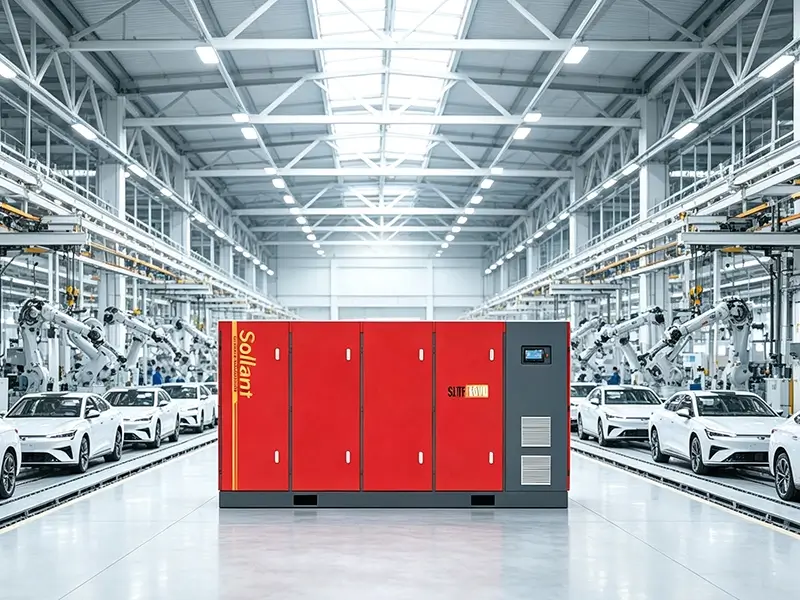
In automotive manufacturing, compressed air is not merely an optional auxiliary energy source; rather, it is critical infrastructure integral to processes such as stamping, painting, assembly, inspection, cleaning, and automated control. The stability, cleanliness, and pressure quality of the compressed air directly impact product quality, production efficiency, and the plant’s overall operating costs.
Why is compressed air critical for automotive plants?
Compressed air serves as an indispensable power source and process medium. Pneumatic tools—characterized by rapid response, high torque, compact size, and spark-free operation—are ideally suited for fastening and grinding tasks on assembly lines. Robotic grippers and pneumatic cylinders require stable pressure to ensure positioning accuracy, while paint spray guns rely on compressed air for atomization and transport, with air quality directly determining the finish of the paint film.
Reliability is directly linked to the production line’s OEE (Overall Equipment Effectiveness). Automotive plants often operate on a “just-in-time” basis; a compressed air interruption of even a few minutes can cause welding clamps to release, halt paint lines, or disrupt the rhythm of final assembly. For large North American automakers, annual electricity costs for compressed air systems can run into the millions of dollars, with downtime losses resulting from system failures being even higher.
Air quality is closely tied to product compliance. Defects such as paint flaws, welding porosity, and contamination of electronic components can often be traced back to oil mist, moisture, or particulates in the compressed air. As the proportion of electric vehicle batteries and precision electronic components increases, requirements for oil-free air and ultra-low dew points have become increasingly stringent.
There is immense pressure regarding energy efficiency and cost control. Compressed air systems typically account for 10% to 20%—or sometimes even more—of a plant’s total electricity consumption. Through measures such as leak management, variable frequency drives (VFDs), heat recovery, and pressure optimization, many plants can achieve system energy savings of 20% to 40%, often with a payback period of less than two years.
In short, compressed air acts as the “muscle” of production, the “blood” of quality, and a “multiplier” of costs. Failure to manage it effectively compromises both quality and efficiency, whereas proper management enhances both product consistency and operational competitiveness.
Key Applications of Compressed Air in Automotive Manufacturing
To understand the importance of compressed air, we need to step onto the factory floor and see how it drives production behind the scenes.
1. Final Assembly Workshop
On the final assembly line, pneumatic tools are indispensable for tasks ranging from tightening tires and fastening bolts to handling and positioning components. Compressed air provides these tools with consistent torque and rotational speed; the tools themselves are stable, safe, reliable, and compact, capable of continuous operation without generating excessive heat or requiring complex electrical systems. Unstable air pressure—even minor fluctuations—can directly compromise bolt torque precision, creating potential safety and quality risks.
2. Paint Shop
The paint shop is the most demanding environment for compressed air applications. Here, compressed air performs three major tasks: conveying and atomizing paint, blowing moisture and dust off the vehicle body, and powering various valves and tools. Air spraying processes utilize compressed air to create negative pressure, atomizing the paint and depositing it evenly onto the vehicle’s surface.
As consumer expectations for paint finishes become increasingly stringent, some manufacturers have even pledged that their paintwork will not discolor for a decade. Achieving this requires that the compressed air be absolutely free of oil, moisture, and solid particles; otherwise, defects such as particles, craters, or runs (sagging) may appear on the finish, necessitating extensive rework.
3. Body Welding and Cutting
In processes such as laser welding and plasma cutting, compressed air often serves as an assist gas. It is used to generate high-pressure plasma jets or shield the weld seam from oxidation, thereby enhancing weld strength and aesthetic quality.
4. Automated Production Lines and Robotics
Modern “lights-out factories” rely heavily on pneumatic robotic arms, lifts, and conveyor systems. For instance, certain conveyor systems use clean compressed air to create an air film, allowing workpieces to glide smoothly with minimal friction. The quality of the compressed air directly determines the precision and consistency of the movements performed by this sophisticated automated equipment.
How Compressed Air Affects Product Quality
If we liken a compressed air system to the human circulatory system, then “unclean blood” leads to disease in organs throughout the body. In automotive manufacturing, the quality of compressed air directly determines paint finish, equipment lifespan, assembly precision, and production cycle times.
1. A Direct Determinant of Paint Finish Quality
In the painting process, the consequences of substandard compressed air quality are immediate and irreversible. Moisture can cause paint runs (sagging), reduced film adhesion, and even blistering; oil mist creates craters on the vehicle body surface—commonly known as “fish eyes”—resulting in an uneven finish; and dust particles can become embedded in the paint layer, creating visible bumps.
Industry Standards:
For automotive painting operations, the industry generally requires compressed air quality to meet Class 2 or Class 3 standards under ISO 8573-1. Specific requirements include: dust particle sizes no larger than 1 μm, extremely low oil content, and a pressure dew point typically between -20°C and -40°C to ensure no liquid water condenses, even in low-temperature environments. For specific metrics regarding various stages, please refer to professional compressed air purity standards to ensure system design compliance.
2. Equipment Reliability and Measurement Accuracy
Pneumatic stamping equipment, precision instruments, and measuring devices are highly sensitive to compressed air quality. Moisture in the air can corrode internal piping and pneumatic valve spools, leading to operational sticking or seal wear. For high-precision tightening tools or measurement sensors on assembly lines, fluctuations in air pressure directly affect reading accuracy; this can lead to quality control errors, such as misclassifying good parts as defective or allowing flawed products to pass through.
3. Chain Reactions Across the Supply Chain
In traditional linear supply chain models, information barriers exist between equipment manufacturers and vehicle OEMs. Unstable air supply quality can shorten the lifespan of tools and consumables at specific stages (e.g., frequent filter clogging), triggering unplanned downtime. Such downtime can create a “bullwhip effect” throughout the upstream and downstream supply chain, disrupting production schedules and causing delivery delays.
Optimizing Compressed Air Systems for Enhanced Quality and Efficiency
Given the critical importance of compressed air, how can automotive manufacturers build a system characterized by “zero downtime, zero leakage, and zero waste”? This requires a three-pronged approach: precise design and equipment selection, intelligent control, and quality monitoring.
1. Precise Air Supply Design
Many factories suffer from excessively high supply pressures or wasted air volume. For every 1-bar increase in pressure, energy consumption rises by approximately 7%.
Zoned Air Supply: Implement independent piping networks or pressure-boosting equipment for areas with varying cleanliness requirements, such as paint shops and final assembly lines. For instance, a BMW plant addressed the high-pressure needs of an assembly line by using a booster to raise standard compressed air from 0.6 MPa to 1.2 MPa; this met process requirements while avoiding the massive energy waste associated with raising the pressure across the entire plant’s piping network.
Variable Speed Drive (VSD) Application: Traditional start-stop controls for air compressors are slow to respond and prone to wasting energy through high-pressure spikes. Compressors equipped with VSD technology adjust motor speed based on real-time air demand, keeping pressure fluctuations within a very narrow range and significantly reducing energy consumption.
2. Intelligent Control Systems
Toyota’s engine plant in Huntsville, Alabama, offers a classic case study. Originally, due to an outdated control system, the plant had to maintain a system pressure of 91 PSI (approx. 6.3 bar) to ensure that end-point equipment received the required 81 PSI during peak demand periods, resulting in significant energy waste.
By upgrading to an intelligent master control system based on CompactLogix and ControlLogix PLCs and adding a large-capacity air receiver tank, the plant achieved the following:
Narrowed Pressure Band: The system setpoint was reduced from 91 PSI to 85 PSI, significantly lowering energy consumption.
Load Balancing: The new system monitors air pressure and flow in real-time, automatically starting/stopping compressors or distributing loads, while utilizing the air receiver tank to handle instantaneous peak demands.
Visualized Operations and Maintenance: Staff can remotely access near real-time system data; the system sends SMS alerts immediately upon detecting pressure drops or leaks. This retrofit helped the Toyota plant save nearly 1 million kWh of electricity annually and recover its investment in less than two years.
3. Rigorous Drying and Filtration
To meet the Class 2 or Class 3 standards specified in ISO 8573-1, it is essential to install high-efficiency refrigerated or desiccant dryers (the latter for low dew-point requirements) alongside multi-stage precision filters (including coalescing filters to remove oil mist). When constructing new paint shops, automotive plants must pay particular attention to controlling pipeline cleanliness; this involves not only installing high-precision equipment but also rigorously purging and cleaning the piping during the commissioning phase to prevent construction residues—such as welding slag and rust—from entering downstream equipment.
4. Leakage Management and Maintenance
Compressed air leakage represents one of the most significant sources of hidden waste in factories. It is estimated that leakage rates in most plants range from 20% to 30%. Adopting a full lifecycle management approach—which includes conducting regular ultrasonic leak detection and promptly replacing aging seals—is a crucial step toward achieving the goal of “zero waste.”
FAQs
Q: How strict are the requirements for compressed air in the automotive painting process?
A: Extremely strict. To ensure a flawless, mirror-like finish, the compressed air must meet at least Class 2 or Class 3 standards under ISO 8573-1. This means solid particles must be no larger than 1 micron, the pressure dew point must be between -20°C and -40°C, and the air must be virtually oil-free. Any excess moisture or oil droplets can cause paint defects such as “fish-eyes” (craters) or runs/sags.
Q: What are the consequences of not using high-quality compressed air, aside from paint finish issues?
A: The consequences are multifaceted. Beyond paint defects, moisture-laden compressed air can corrode precision pneumatic valves and cylinders, shortening equipment lifespan and causing operational failures. Unstable pressure can lead to incorrect bolt torque, compromising vehicle safety. Additionally, increased system resistance and frequent maintenance requirements reduce production efficiency and raise operating costs.
Q: How can automotive plants reduce the high energy consumption of compressed air systems?
A: There are three main approaches: first, using variable-frequency drive (VFD) air compressors to automatically adjust output based on real-time demand; second, optimizing pipeline network pressure to avoid excessively high settings (reducing pressure by 1 bar can save approximately 7% in energy); and third, implementing intelligent group control systems to coordinate multiple compressors and utilizing air storage tanks to minimize or eliminate no-load running.
Q: Can electric tools completely replace pneumatic tools in the final assembly workshop?
A: Not at present. Pneumatic tools offer advantages such as high power density, no risk of overheating, durability, and relatively low costs, making them ideal for automotive assembly lines requiring prolonged, high-frequency operation. Although electric tools—particularly brushless servo tools—have improved in precision control, compressed air-driven tools remain the preferred choice for heavy-duty fastening and extreme operating conditions.
Conclusion
Compressed air—an industrial resource that may appear free—is, in reality, the “high-value lifeblood” of automotive manufacturing. It not only exerts a significant, often overlooked influence on production costs (accounting for 12%–40% of energy consumption) but also directly determines the visual quality and core performance of the vehicle through its purity and stability.
In the fiercely competitive automotive market, even the slightest paintwork defect can trigger customer complaints, while a single production line stoppage can result in losses amounting to tens of millions. Therefore, optimizing compressed air systems is not merely a means to cut costs and boost efficiency; it is a strategic move to enhance core product competitiveness. By strictly adhering to compressed air purity standards such as ISO 8573-1, adopting advanced technologies like intelligent group control and variable frequency drives, and implementing meticulous lifecycle management, automotive manufacturers can truly harness this powerful, invisible force—accelerating their journey toward “zero-defect” and “zero-carbon” smart manufacturing.
Related Articles
Request a Quick Quote Now

Shandong Sollant Machinery Manufacturing Co., Ltd.
20 years of professional export experience. Our twin-screw air compressor is very popular in the international market.
