
Screw Compressors
A technological revolution surpassing piston compressors, redefining compressed air solutions.
Why choose screw compressors? – A complete technological paradigm shift
The replacement of piston compressors with screw compressors is not merely a product upgrade, but a fundamental shift in compression technology from intermittent, reciprocating motion to continuous, smooth rotary motion. This transformation has completely reshaped the design philosophy of compression methods and established new standards in energy efficiency, reliability, and overall economic benefits.
We are committed to providing businesses with smarter, more stable, and more energy-efficient compressed air system solutions, supporting industrial upgrading and reducing operating costs.
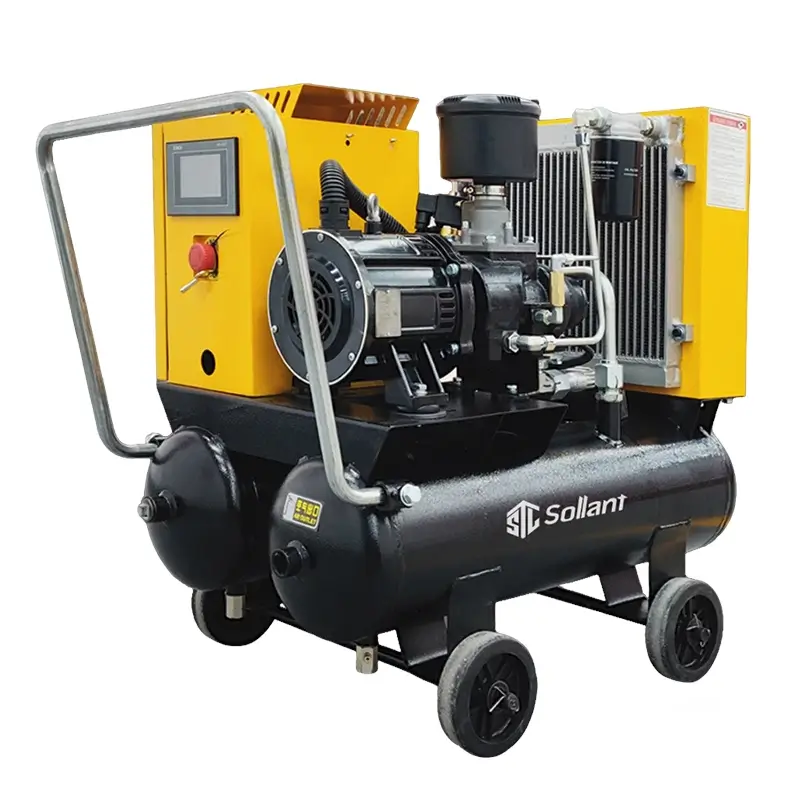
Screw Compressors vs. Piston Compressors
A Comparison of Revolutionary Advantages
.webp)
A detailed explanation of the core advantages of our screw compressors.
Ultra-high reliability, continuous and stable gas supply
Utilizing advanced rotor design and precision manufacturing processes, with no reciprocating moving parts, resulting in minimal wear and low failure rate. It can achieve 24-hour continuous operation, significantly improving production continuity.
Superior energy efficiency, reducing operating costs.
The optimized screw design improves airflow paths and achieves high volumetric efficiency, resulting in over 30% energy savings compared to traditional piston compressors. The intelligent control system automatically adjusts output based on air demand, preventing energy waste.
Pure and stable air supply ensures process quality.
The output airflow is continuous, pulse-free, and has low oil content, making it suitable for industries with high air source quality requirements, such as precision manufacturing, food and pharmaceuticals, and electronic instruments.
Applicable Industries for Screw Compressors

Keep us Update on Latest Air Compressor Newsletter
Screw Compressors: Why are they considered a complete revolution in piston compressor technology?
In modern industrial production, compressed air is widely used as an important power source in various fields. The core equipment that provides compressed air—the air compressor—has also undergone continuous technological evolution. Among the many types of compressors, the screw compressor, with its superior performance and wide range of applications, is hailed as a “complete revolution” in traditional piston compressor technology. This article will delve into the working principle of screw compressors, compare them with piston compressors, and explore the five revolutionary pillars that make them the preferred choice in the industrial sector.
I. Screw Compressors vs. Piston Compressors: The Working Principles of Two Technologies
Before a detailed comparison, we first need to understand the working principles of these two different types of compressors: screw and piston.
Piston Compressor: Its working principle is similar to the piston movement of an internal combustion engine. The motor drives the crankshaft to rotate, and the crankshaft then drives the connecting rod to make the piston move reciprocally in the cylinder. When the piston moves downward, gas enters the cylinder through the intake valve; when the piston moves upward, the intake valve closes, the gas is compressed, and then discharged through the exhaust valve. Piston compressors usually operate intermittently, and the output airflow has a certain pulsation.
Screw Compressor: This type uses a pair of intermeshing helical rotors (male and female rotors). When the motor drives the rotors to rotate, gas enters the space between the rotors from the intake port. As the rotors rotate, the space gradually decreases, and the gas is continuously compressed and discharged from the exhaust port. The screw compressor is a positive displacement gas compressor, and its operation is continuous, resulting in a smooth, pulsation-free output airflow.
II. Comparison of Screw Compressors and Piston Compressors
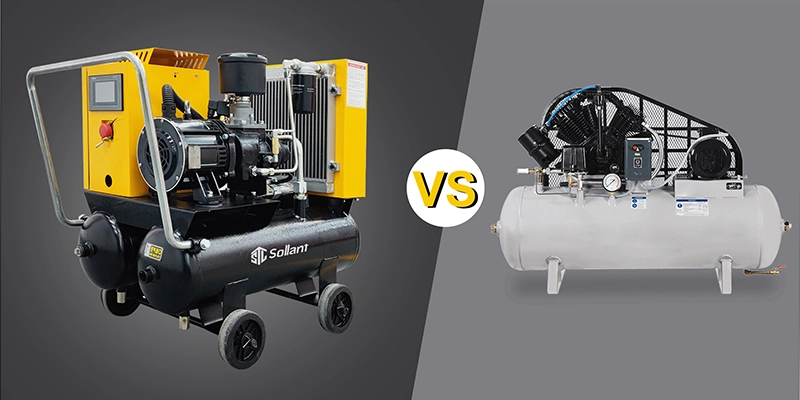
| Features/Type | Screw compressor | Piston compressor |
| Operating Principle | Continuous, pulsation-free | Intermittent, pulsating |
| Efficiency | High efficiency, especially under continuous operation. | Relatively low efficiency, especially under varying load conditions |
| Reliability | High efficiency, fewer moving parts, and less wear and tear. | Relatively low reliability due to many moving parts and susceptibility to wear |
| Noise and Vibration | Low noise, low vibration | High noise and vibration levels |
| Maintenance Costs | Low | High maintenance costs |
| Air Quality | The outlet air has high purity (especially for oil-injected screw compressors, which require further treatment). | Higher oil content in the outlet air, requiring more effective oil-water separation |
| Footprint | Compact design, small footprint. | Relatively large size |
| Investment Cost | The initial investment is usually high. | Relatively low initial investment |
| Applicable Scope | Continuous, high-flow, and highly stable application scenarios | Suitable for intermittent, low-flow applications |
III. Five Pillars of the Screw Compressor Revolution
The reason why screw compressors have achieved a complete revolution in piston technology is due to their significant advantages in the following five aspects:
- Unparalleled Reliability and Lower Maintenance Costs
Due to its unique rotary working principle, screw compressors have fewer moving parts and no reciprocating motion impact, resulting in less wear and a lower failure rate. Compared to piston compressors, screw compressors have a simpler structure and fewer wear parts, allowing for long-term stable operation and significantly reducing maintenance frequency and costs. This means businesses can reduce downtime, improve production efficiency, and achieve higher economic benefits.
- Excellent Energy Efficiency: How Screw Compressors Save Operating Costs
Energy consumption is a major component of compressor operating costs. Screw compressors are designed with higher volumetric efficiency, especially with the support of variable frequency drive technology, which intelligently adjusts the motor speed according to actual air demand, avoiding the inefficient operation of traditional piston compressors under partial load. This makes screw compressors perform exceptionally well in energy saving, significantly reducing operating costs for businesses and is key to achieving green production and sustainable development.
- Industrial Screw Compressors Provide Clean and Stable Air Quality
The airflow output of screw compressors is smooth and pulsation-free, which is crucial for many industrial applications that require strict airflow stability. Furthermore, modern screw compressors, especially oil-free screw compressors, can provide completely oil-free compressed air, effectively preventing oil contamination of products and equipment. Even oil-injected screw compressors, through efficient oil-gas separation systems, can ensure extremely low oil content in the outlet air, meeting most industrial needs. Clean and stable air quality is particularly important for the food, pharmaceutical, and electronics industries.
- Quiet and Compact Design of Modern Screw Air Compressors
Due to their continuous rotating operation, screw compressors generate significantly less noise and vibration than piston compressors. Modern screw compressors generally adopt an integrated silent enclosure design, further reducing noise pollution and creating a more comfortable working environment for operators. At the same time, their compact structural design results in a small footprint, facilitating installation and layout, and is particularly suitable for factories with limited space.
- Intelligent Control and Connectivity: The Era of Smart Screw Compressors
With the development of the Internet of Things and Industry 4.0, modern screw compressors generally integrate advanced intelligent control systems. Through functions such as touch screens, remote monitoring, and fault diagnosis, users can monitor the compressor’s operating status in real time, and perform remote operation and maintenance management. This intelligent and interconnected design not only improves the operating efficiency and reliability of the equipment but also significantly reduces the need for manual intervention, providing businesses with more convenient and efficient compressed air solutions.
IV. Is the screw compressor always the best choice?
Although screw compressors have many advantages in performance, they are not always the absolute best choice in all situations. For applications with intermittent, low air consumption and low requirements for noise and air quality, piston compressors still have a certain market competitiveness due to their lower initial investment cost and simple maintenance.
However, for most industrial production, especially in applications requiring continuous, stable, high-flow, and high-quality compressed air, the advantages of screw compressors in terms of long-term operating costs, reliability, energy efficiency, and ease of maintenance make them the undisputed first choice.
Conclusion
With its superior reliability, energy efficiency, air quality, quiet and compact design, and intelligent control, the screw compressor has indeed revolutionized traditional piston compressor technology. It not only improves the efficiency and quality of industrial production but also brings significant economic benefits and sustainable development opportunities to businesses. With continuous technological advancements, screw compressors will undoubtedly play an even more important role in the future industrial sector.
FAQ
Q1: Are screw compressors more expensive than piston compressors?
A1: Generally, the initial investment cost of a screw compressor is higher than that of a piston compressor. However, in the long run, the advantages of screw compressors in terms of energy efficiency, maintenance costs, and reliability often lead to lower overall operating costs.
Q2: Do screw compressors require regular maintenance?
A2: Yes, screw compressors also require regular maintenance, such as replacing lubricating oil and filters. However, compared to piston compressors, their maintenance cycle is longer, and the maintenance procedures are simpler.
Q3: What is the difference between oil-free screw compressors and oil-injected screw compressors?
A3: Oil-free screw compressors do not come into contact with lubricating oil during the compression process, thus providing completely oil-free compressed air, suitable for industries with extremely high requirements for air cleanliness. Oil-injected screw compressors lubricate and cool the rotors with lubricating oil. The discharged air contains a small amount of oil, but this can be reduced to a very low level through a high-efficiency oil-gas separator.
Q4: How do I choose the right screw compressor for me?
A4: Choosing the right screw compressor requires considering several factors, including air consumption requirements, pressure requirements, air quality requirements, operating time, and budget. It is recommended to consult a professional compressor supplier to select the appropriate model based on your specific needs.
