
How to Choose the Right Air Compressor for Drilling Equipment?
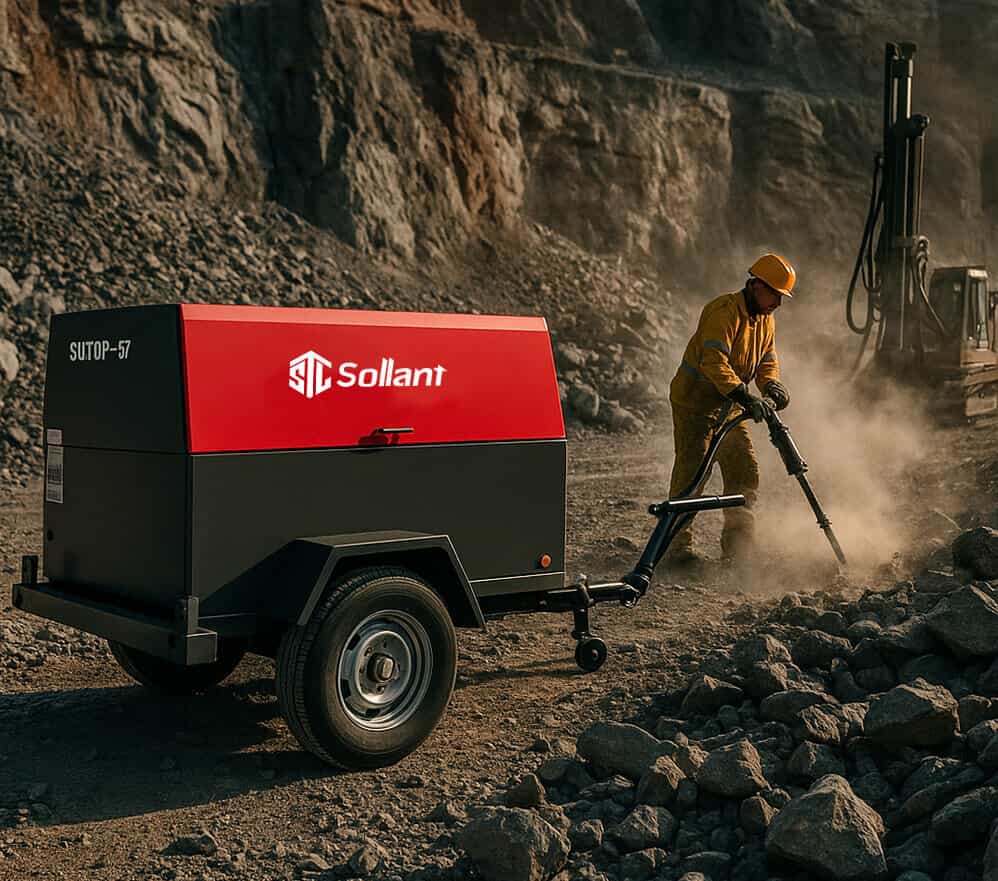
In the drilling industry, compressed air serves not only as a power source but also as a critical factor influencing drilling efficiency, hole-bottom cleaning, equipment stability, and operational costs. For applications such as mining, water well drilling, geothermal drilling, and construction piling, the choice of air compressor often directly determines whether a project can proceed efficiently.
When selecting compressors for drilling operations, many users focus solely on whether the pressure is sufficient, often overlooking factors such as airflow rate, continuous operating capability, the working environment, and drilling depth. In reality, the requirements drilling equipment places on compressors are far more complex than those for general industrial air applications; only by matching specifications to actual operating conditions can the equipment’s performance be fully realized.
Why Do Drilling Rigs Need Air Compressors?
Air compressors are indispensable to drilling operations because compressed air performs several critical functions throughout the drilling process: driving drilling tools, clearing cuttings, cooling equipment, stabilizing borehole walls, and even directly participating in the hole-forming process in certain techniques. Without sufficient compressed air, drilling efficiency drops significantly, and the effectiveness of hole cleaning is compromised.
1. The Role of Compressors in Drilling
The role of compressors in drilling equipment is primarily reflected in the following aspects:
- Providing power to drive pneumatic down-the-hole (DTH) hammers, pneumatic tools, or related auxiliary systems.
- Expelling rock cuttings and dust from the borehole to keep the hole bottom clean.
- Cooling the drill bit and related working components to extend their service life.
- Stabilizing airflow within the well or borehole to improve the quality of the hole formation.
- Helping to maintain drilling speed and operational continuity in specific processes.
For DTH drills, rotary drilling rigs (where air serves as an auxiliary source), water well drilling equipment, and geothermal rigs, the air compressor is an essential core component.
2. Varying Compressed Air Requirements for Different Drilling Methods
Requirements for air parameters vary significantly depending on the drilling method. For example:
- Mining drilling typically requires high airflow and medium-to-high pressure to drive DTH hammers for rapid rock breakage.
- Water well drilling focuses more on hole depth, cuttings removal capability, and continuous, stable operation.
- Geothermal drilling often demands higher pressure and greater durability to handle deep, hard rock formations.
- Construction piling drilling emphasizes mobility, adaptability to the job site, and the ability to provide a continuous air supply.
Consequently, there is no single standard for drilling compressors; the choice must be determined by comprehensively considering the drill rig type, geological conditions, and project objectives.
Common Types of Air Compressors for Drilling Equipment
Air compressors commonly used in the drilling industry fall into three main categories: diesel-powered portable screw air compressors, electric screw air compressors, and high-pressure air compressors. Different types are suited to specific operating conditions; selecting the wrong equipment can lead to increased energy consumption, reduced drilling efficiency, and even compromised safety.
1. Diesel-Powered Portable Screw Air Compressors
Diesel-powered portable screw compressors are a staple in the drilling industry, particularly for operations in remote areas, mines, mountainous terrain, and water well construction where a stable power supply is unavailable. Their key advantages include high mobility, an integrated power system, and broad adaptability, allowing for stable operation under harsh conditions.
Advantages:
- No external power supply required; ideal for field operations.
- Highly mobile and flexible; easy to move alongside the drilling rig.
- Suitable for complex worksites such as mines, tunnels, slopes, and water well sites.
- Mature design with a well-established maintenance system.
Typical Applications:
- Mining DTH (Down-the-Hole) drilling
- Water well drilling rigs
- Geothermal exploration
- Field engineering drilling
- Temporary construction projects
2. Electric Screw Air Compressor
Electric screw compressors are suitable for construction environments with a stable power supply, such as factory complexes, fixed job sites, and certain urban infrastructure projects. They are characterized by low operating costs, relatively low noise levels, and ease of maintenance, offering excellent cost-efficiency during long-term, continuous operation.
Advantages:
- Low energy costs.
- Stable operation.
- Relatively simple maintenance.
- Suitable for continuous operation.
Applicable Scenarios:
- Fixed drilling stations
- Urban construction sites
- Projects with reliable power supply
- Long-duration, continuous operations
3. High-Pressure Air Compressors
High-pressure air compressors are typically used for deeper and more challenging drilling operations. They deliver higher working pressures, meeting the power and cuttings-removal requirements of applications such as deep-well, hard-rock, and geothermal drilling. These units are crucial for projects that demand high standards of compressed air quality and stability.
Advantages:
- Capable of delivering higher pressure.
- Better suited for deep-hole and hard-rock operations.
- Helps enhance drilling performance.
- Suitable for complex and demanding operating conditions.
Applications:
- Deep-well drilling
- Geothermal drilling
- Hard-rock drilling
- High-demand engineering drilling
| Compressor Type | Key Features | Applications |
| Portable Diesel Screw Compressor | Highly flexible and self-powered, requiring no external power supply; capable of independent operation in remote areas. Rugged and durable, designed to withstand harsh environments. | Suitable for scenarios such as mining, water well drilling, and geothermal drilling—particularly in locations beyond the reach of the power grid or where frequent relocation is required. |
| Electric Screw Compressor | Offers low operating costs, reduced noise and emissions, and compliance with environmental standards. It is a more economical choice for sites with a reliable, high-capacity power supply. Certain models feature Variable Speed Drive (VSD) technology, delivering significant energy savings. | Suitable for urban construction piling, centralized mining operations with a stable power grid, and areas subject to strict environmental and noise regulations. |
| High-Pressure Air Compressor | Typically operates at pressures of 25–35 bar or higher; specifically designed for deep-hole drilling and hard-rock drilling applications. | Suitable for deep water wells, deep geothermal projects, and deep-hole blasting operations in large-scale mining. |
Key Factors to Consider When Selecting a Drilling Compressor
1. Working Pressure
Pressure determines impact energy and cuttings removal capability. DTH hammers typically require the rated pressure to be achieved at the hammer inlet:
- Soft to medium-hard formations, shallow holes: 10–15 bar
- Medium-hard to hard rock, medium-depth holes: 15–25 bar
- Extremely hard rock, deep holes, or large diameters: 25–35 bar and above
Allowances must be made for pressure losses in lines, fittings, and filters (approx. 5–7 psi per 30 m of hose) as well as a safety margin. The compressor’s rated pressure should be slightly higher than the actual requirement.
2. Airflow (CFM or m³/min)
Airflow determines the cuttings removal velocity and the hammer’s cycling frequency. Insufficient airflow leads to cuttings accumulation at the hole bottom and reduced penetration rates, while excessive airflow wastes fuel. Calculations should account for hole diameter, drill rod outer diameter, upward air velocity, and depth correction factors.
3. Drilling Depth and Hole Diameter
Increased depth raises annular resistance and pressure loss, requiring higher pressure and greater airflow. Larger hole diameters result in a larger annular area, significantly increasing the required airflow; for instance, the airflow requirement difference between a 6-inch hole and an 8-inch hole can be several hundred CFM.
4. Operating Environment
- High altitude: Air density decreases, causing a drop in air output and engine power (approx. 3% loss per 300 m); selection must be adjusted for altitude, prioritizing turbocharged engines.
- High temperature and dust: Requires excellent heat dissipation, efficient air filtration, and high protection ratings (IP54/IP55 or higher).
- High humidity or water inflow: Oil-water separation and air drying capabilities must be considered.
- Mobility: Trailer, crawler, or truck-mounted configurations must suit road and site conditions.
5. Continuous Operation Time
Drilling often involves long periods of continuous operation. Prioritize models designed for 100% continuous duty cycles that feature large fuel tanks, low fuel consumption, and ease of maintenance; also consider service intervals and spare parts availability.
How are the key parameters for drilling air compressors matched?
The core principle of matching is: “Pressure meets hammer requirements + Flow rate meets cuttings evacuation needs + Environmental corrections + Safety margin.”
Basic steps:
- Determine the rated pressure and recommended air volume for the specific DTH hammer model being used.
- Calculate the annular area based on the maximum borehole diameter and drill rod outer diameter, then set the target upward air velocity (using higher values for hard rock and wet formations).
- Apply depth correction factors and water inflow coefficients.
- Add a 15–25% safety margin and adjust for altitude and temperature.
Select a compressor capable of stably delivering the required flow rate at the target pressure; prioritize reviewing the full performance curve rather than relying on a single nominal value.
Recommended Compressors for Common Drilling Applications
1. Mining Drilling
Down-the-hole (DTH) drilling is commonly used for open-pit blast holes and exploration holes. Recommended equipment: diesel-powered, portable, two-stage rotary screw compressors with pressures of 20–25 bar and flow rates of 750–1100 CFM (or higher). Units must feature dust resistance, high-temperature tolerance, and the capability for continuous, heavy-duty operation. High-capacity models or parallel unit configurations are typical for large-scale production drilling.
2. Water Well Drilling
- Shallow wells (<100 m): 300–500 CFM, 100–150 PSI class.
- Medium-depth wells (100–300 m): 500–900 CFM, 15–25 bar.
- Deep wells (>300–500 m): 900–1500 CFM, 25–35 bar.
High-pressure, high-flow models are preferred for hard rock formations; diesel-powered portable units are the standard choice.
3. Geothermal Drilling
Shallow geothermal (approx. 150 m): ~20 bar, ~20 m³/min.
Deep geothermal (1000 m range): 24–35 bar, 30–40 m³/min or higher; often requires parallel unit configurations or the addition of a booster compressor. Extremely high requirements for continuous operation and adaptability to high-temperature environments.
4. Construction Piling/Borehole Drilling
Characterized by large diameters and moderate depths; requires high airflow for rapid cuttings removal. Pressure settings depend on rock hardness (typically 15–25 bar). Portability and the ability to relocate quickly between sites are critical.
Why Choose Sollant Air Compressors for Drilling?
Sollant specializes in air compressors for industrial and engineering applications. Its product lineup includes diesel-powered portable screw compressors and high-pressure models, suitable for operations such as mining, water well drilling, geothermal projects, and pile foundation work. Key advantages include:
- High-efficiency two-stage airend design: Features large rotors operating at low speeds, resulting in high compression efficiency, low discharge temperatures, and significant theoretical energy savings—ideal for prolonged, continuous operation.
- Broad operational range: Pressure and flow rate specifications meet the requirements of most DTH (Down-The-Hole) hammers and borehole diameters, while portable models facilitate easy site-to-site transport.
- Environmental adaptability: Enhanced cooling, filtration, and engine configurations ensure high reliability in challenging conditions, such as high-dust, high-temperature, and high-altitude environments.
- Low operating costs and easy maintenance: Excellent fuel economy and extended service intervals, combined with high parts interchangeability and robust service support, help minimize the total cost of ownership.
- Customization and integration capabilities: Units can be tailored to specific pressure, flow, emission, and structural requirements, and integrated with drilling rigs and hammers to provide a comprehensive solution.
While actual specification matching remains the primary factor when making a selection, choosing a professional brand typically ensures greater reliability in performance, fuel economy, and after-sales support.
Conclusion
Selecting the right compressor for drilling equipment hinges on accurately assessing working pressure, air flow, drilling depth and hole diameter, operating environment, and continuous operation requirements, while ensuring precise compatibility with the specific Down-the-Hole (DTH) hammer and geological conditions. Properly calculating CFM and pressure requirements—while incorporating safety margins and environmental correction factors—can significantly boost drilling efficiency and reduce both fuel consumption and failure rates. Since parameter requirements vary widely across applications such as mining, water well drilling, geothermal projects, and piling, equipment selection must be tailored to the specific use case. Mobile diesel screw compressors have become the industry standard due to their mobility and high-pressure, high-flow capabilities; meanwhile, brands specializing in engineering applications—such as Sollant—offer users reliable performance regarding airend efficiency, environmental adaptability, and total lifecycle costs. Proper equipment selection is not merely a procurement decision but a critical factor in project success and cost control. It is recommended to perform detailed calculations based on specific hammer parameters, site geology, and drilling depth, and to consult professional suppliers for performance curve verification and solution optimization when necessary.
Request a Quick Quote Now

Shandong Sollant Machinery Manufacturing Co., Ltd.
20 years of professional export experience. Our twin-screw air compressor is very popular in the international market.
