
How the Mining Industry Uses Air Compressors
Imagine working hundreds or even over a thousand meters underground—dark, damp, full of dust and toxic gases. How do miners breathe down there? How do massive drills break through solid rock? How does ore get pushed up through pipes to the surface? The answer in every case is compressed air.
As demand for mineral resources grows around the world and mining becomes more challenging, modern operations are putting unprecedented pressure on air compressor performance, energy efficiency, and reliability. To learn more about how air compressors keep mining applications running smoothly, check out the info below!
Why Air Compressors Matter in Mining
Air compressors aren’t just nice to have in mining—they’re essential. Their impact touches safety, productivity, costs, and even the environment.
1. Safety: A Core Piece of the Puzzle
Mining conditions are tough and unpredictable. Underground, you’re dealing with gas buildup, explosive dust, and low oxygen. Compressed air runs on power, but not electricity—which means no sparks. That’s a huge deal in coal mines or anywhere a single spark could set off a disaster.
Compressed air also keeps ventilation going, pushing fresh air into the workface while pulling out harmful gases and dust. And when things go wrong? It supplies air to emergency shelters and powers rescue tools. Many mine rescue operations depend on pneumatic gear—and that gear depends on a reliable compressor.
2. Getting More Work Done, Faster
Tools powered by compressed air—like rock drills, jackhammers, and picks—are lighter and take more abuse than electric ones. They handle damp, cramped spaces better and keep running with less downtime.
On top of that, pneumatic conveying systems move ore and tailings efficiently, cutting down on heavy manual labor.
3. Saving Money and Energy Over Time
Sure, a good compressor costs more upfront. But a high-efficiency unit pays for itself. With variable speed drives (VSD) and heat recovery systems, modern compressors can cut energy use by 20–35%. When power prices jump—and they always do—that kind of saving goes straight to the bottom line for a large mine.
4. Cleaner, Quieter, Greener
Oil-free compressors and low-noise designs help mines meet stricter environmental standards. They cut down on oil spills and noise complaints. Compressed air also enables dry drilling and dust control methods that reduce emissions and protect the land around the mine.
You could call compressed air the heartbeat of a mine. It’s not some backup tool or nice-to-have extra. Without a steady supply of compressed air, almost everything grinds to a halt.
Main Applications of Air Compressors in Mining
Air compressors show up in just about every stage of a mining project—from exploration and drilling to moving material and refining ore. Here are the six biggest ways they’re used on site.
1. Drilling and Rock Drilling
Before you can blast, you need to drill holes in solid rock to place the explosives. This is where down-the-hole (DTH) drills and pneumatic rock drills (jackhammers) take over. The compressor sends high-pressure air to power the drill’s hammering action, breaking rock with every hit. But that’s not all—that same air also blows the rock dust and cuttings out of the hole so the bit doesn’t get stuck.
For this kind of work, you’re typically looking at high-pressure air, anywhere from 1.0 to 3.5 MPa, with a lot of flow behind it.
2. Pneumatic Tools and Equipment Drives
It’s not just big drills. Mines are full of smaller pneumatic tools for daily maintenance and odd jobs, like:
Impact wrenches, grinders, jackhammers – used for fixing heavy haul trucks and conveyor belts right on the spot.
Air-powered pumps – great for clearing water out of pits or tunnels. Diaphragm pumps don’t mind running dry and can handle nasty, muddy water full of debris.
Air winches and motors – used for lifting and moving heavy gear underground. Bonus: they can keep working off stored air in the tank even if the power goes out.
3. Ventilation and Life Support
When the main ventilation system doesn’t reach certain tunnels or workfaces, compressed air gets filtered and piped straight in—through auxiliary fans or refuge station oxygen lines. And in an emergency, like a collapse, that compressed air line can be the only thing keeping trapped miners alive.
4. Shotcreting and Ground Support
To keep underground tunnels from caving in, you need ground support. A lot of modern mines use shotcrete—concrete sprayed right onto the rock. Compressed air pushes the wet or dry mix through a hose and blasts it onto the wall at high speed, where it hardens fast into a strong support layer.
The catch? The air pressure and flow have to be steady. If it surges or drops, the shotcrete comes out uneven or clogs the hose.
5. Pneumatic Conveying
At the processing plant, you’ve got fine ore powders, tailings, and chemicals that need to move long distances. Open conveyor belts kick up dust and lose material. Pneumatic conveying solves that by pushing powders through sealed pipes using compressed air—positive or negative pressure depending on the setup. It’s clean, efficient, takes up less space, and works around tricky mine layouts.
6. Flotation and Process Automation
For non-ferrous metal mines, flotation is the go-to method for separating valuable minerals from waste rock. Compressed air pushes tiny, uniform bubbles through the flotation tank. The good mineral particles stick to the bubbles, float to the top, and get skimmed off as froth.
On top of that, most modern processing plants run on pneumatic control valves, actuators, and explosion-proof switches—all of which need clean, dry, low-pressure instrument air to do their job.
Underground mining vs. open-pit mining: What are the differences in air compressor requirements?
| Dimensions | Underground mining | Open-pit mining |
| Mobile | Primarily stationary, supplying air to the well via a long pipeline network. | Primarily mobile. As the mining face advances, the air compressor must move with the electric shovel and drilling rig. |
| Safety | Explosion-proof and flame-retardant are strict requirements. Electrical sparks must be prevented from igniting methane or coal dust. | Primarily focused on dust and sun protection, explosion-proof requirements are relatively lower, but it must be able to withstand thunderstorms and other severe weather conditions. |
| Space Constraints | The equipment is limited in size, requiring a compact design, and extremely high noise control requirements (due to the confined underground space). | The site must be open, capable of accommodating large units, and even allowing for containerized deployment. |
| Exhaust Requirements | Extremely high oil-gas separation efficiency, with stringent control over oil content and odor (if used in ventilated or densely populated areas). | Meets the high-pressure, high-flow requirements of large-diameter drilling rigs; exhaust quality must not affect drill bit life or slag removal efficiency. |
Comparison of commonly used air compressor types in mining
There are many types of air compressors on the market, but in harsh mining environments, screw air compressors have become the absolute mainstream, gradually replacing the old piston air compressors.
| Type | Advantages | Disadvantages | Applicable Scenarios |
| Screw type | Compact structure, good stability, strong continuous operation capability, low noise | High initial investment, high maintenance requirements | Open-pit mines, high flow rate, continuous operation |
| Piston type | High pressure capability, highly adaptable, compact unit size | High noise, strong vibration, frequent maintenance | Suitable for small mines, localized high-pressure applications, and portable equipment |
| Centrifugal type | High flow rate, high efficiency, suitable for large-scale mining areas | High requirements for gas source quality, large footprint | Large open-pit mines, centralized gas supply systems |
Key considerations for selecting mining air compressors
Picking the right air compressor isn’t just another purchase—it can make or break your mine’s daily operations. Here are the key things you need to think about before deciding.
Air Flow and Pressure
Start by adding up how much air your pneumatic tools need and at what pressure. Don’t just look at average use—you need a compressor that can handle peak demand when everything’s running at once.
The Work Environment
A surface mine and an underground mine are two different worlds. Temperature, humidity, dust levels, and how much space you’ve got—all of these vary wildly. Your compressor needs to be built to handle whatever your specific site throws at it.
Energy Efficiency
A high-efficiency compressor doesn’t just lower your electric bill. It also cuts your carbon footprint. For modern mines trying to go green, this is a real priority.
Maintenance and Lifespan
Mine sites are tough on equipment, and getting repair crews out to remote locations isn’t easy. You want a compressor that’s simple to maintain, built to last, and reliable as hell.
Portability and Installation
On an open-pit mine, you move around a lot as the pit expands. Modular or mobile compressors make way more sense here—you can shift them as needed without tearing everything apart.
Safety Standards
This is especially critical underground. Your compressor needs to meet strict safety requirements—explosion-proof, fire-resistant, dust-tight. At the end of the day, it’s about keeping people alive.
Sollant Diesel Portable Air Compressors in Mining
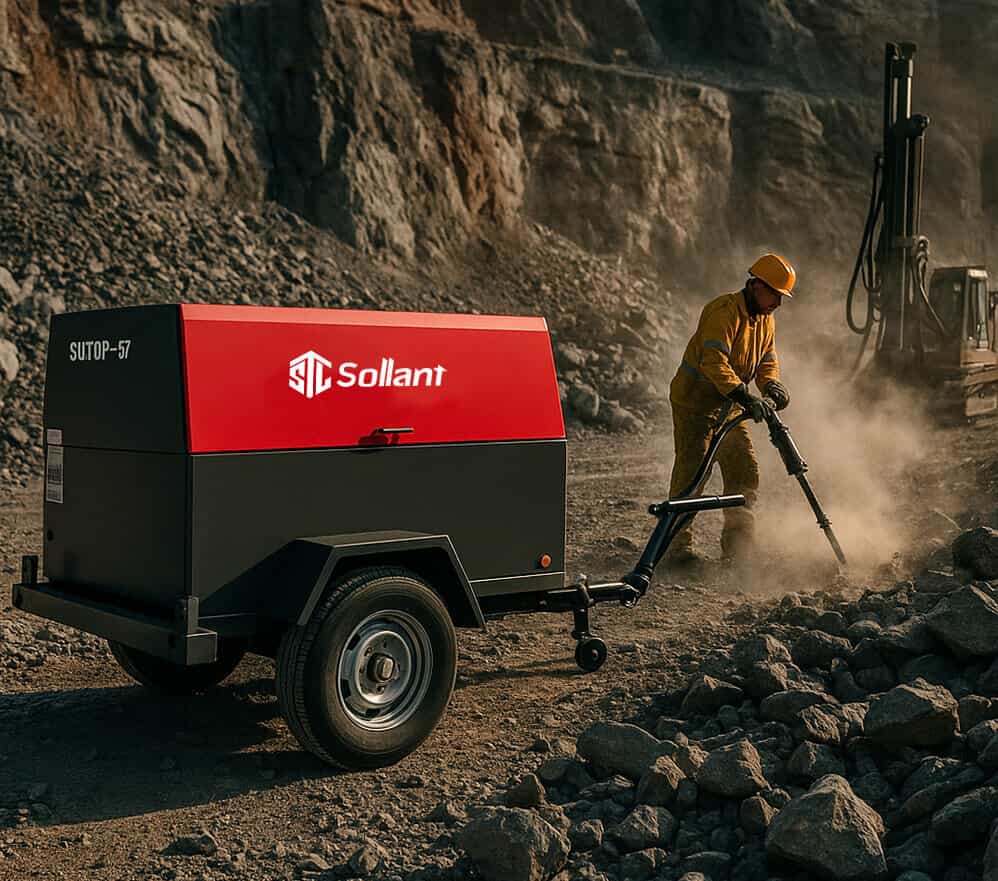
Sollant’s diesel portable air compressors are built for the real world—tough, easy to move, and ready to work. They’re a solid fit for mining operations, especially surface mines and remote sites where bringing in gear isn’t always simple.
Key Features
Portable Design
These compressors come in a compact, trailer-mounted package. No permanent installation needed—just tow them to wherever you need air. That saves space and skips the installation costs.
Strong Output
Pressure ranges from 7 up to 30 bar, with flow rates from 5 to 35 m³/min. That kind of power keeps drills, jackhammers, breakers, and other pneumatic tools running steady—even when demand peaks.
Diesel Powered, Built for Tough Conditions
They run on efficient diesel engines, so you don’t need an external power supply. That’s a huge plus for remote mines or anywhere the grid is unreliable. Plus, good fuel economy helps keep operating costs down.
Durable and Safe
These compressors are built to handle dust, moisture, and vibration—so they keep running day after day in harsh mine conditions. Safety valves, overload protection, and other features help keep the work site safe.
Easy to Maintain
The modular design makes routine maintenance and part swaps pretty straightforward. Less downtime means more time actually working.
Where They’re Used
Surface mines – Move them along as the pit expands. One unit can supply air for multiple tools.
Underground mine entries and support work – Easy to move around for auxiliary fans, ventilation ducts, or short-term jobs.
Remote or temporary sites – No external power needed. These things thrive in rough, off-grid conditions.
In summary, Sollant diesel air compressors offer your business an energy-efficient and cost-effective solution, perfectly combining flexibility and high efficiency, making them an ideal choice for mining companies seeking high productivity, low maintenance costs, and safety and reliability.
Conclusion
Air compressors do a lot more in mining than just supply power. They affect safety, efficiency, and environmental performance all at once. That said, underground and surface mining have very different needs—so picking the right type and setup for your specific operation really matters.
Screw, piston, and centrifugal compressors each have their own strengths. Which one makes sense depends on your work environment, airflow and pressure requirements, and energy efficiency goals. On top of that, reliability, ease of maintenance, and safety protection are just as critical—you can’t afford to overlook them.
As mines become more automated and data-driven, compressors are going to take on even more complex roles. They’ll be a key piece of the smart mine puzzle. Choose wisely, use them well, and you’ll not only boost productivity—you’ll keep your people safer and move closer to real, sustainable mining.
Request a Quick Quote Now

Shandong Sollant Machinery Manufacturing Co., Ltd.
20 years of professional export experience. Our twin-screw air compressor is very popular in the international market.
