
In chemical production processes, air compressors serve as indispensable core power equipment. They provide stable, efficient, and clean compressed air or gas support for various process stages, directly impacting production efficiency, safety, and product quality. As the chemical industry transitions toward intelligent and green operations, the demands for the reliability and energy efficiency of compressed air systems are continuously rising.
Key Applications of Air Compressors in the Chemical Industry
- Gas Conveying and Agitation: Used for the pneumatic transport of powders and granular materials (such as catalysts and plastic pellets), as well as for aeration and agitation within reaction vessels, ensuring uniform material mixing and enhancing reaction efficiency.
- Equipment Cleaning and Purging: High-pressure compressed air is utilized to clean equipment—including pipelines, reaction vessels, and storage tanks—by purging residual chemical substances to prevent cross-contamination and ensure production safety.
- Process Control and Instrumentation Drive: Provides power to pneumatic valves, actuators, and control instruments, enabling precise process control and automated operations.
- Spraying, Atomization, and Coating: Supplies a stable air source for surface treatment, paint spraying, and coating processes, ensuring the uniformity of applied layers.
- Gas Boosting and Separation: Supports gas synthesis, purification, and the air supply for separation towers, as well as assisting in high-pressure processes such as hydrogenation and catalysis.
- Other Specialized Applications: Includes liquid lifting, vacuum or pressure filtration, combustion air assistance, and waste heat recovery; these applications are widely utilized across sectors such as petrochemicals, coal chemicals, and fine chemicals.
The chemical industry operates within complex environments that frequently involve flammable, explosive, toxic, or corrosive media. Consequently, there are exceptionally stringent requirements regarding the explosion-proof performance, corrosion resistance, gas purity (particularly oil-free compressed air), and operational stability of air compressors. Furthermore, energy conservation and cost reduction remain key priorities for enterprises; thus, the adoption of variable frequency drive (VFD) or permanent magnet variable frequency technologies can significantly reduce electricity consumption.
The Critical Role of Air Compressors in Chemical Production
In chemical production, air compressors are by no means merely auxiliary equipment used for “blowing” or “ventilation”; rather, they serve as a core power source and play a critical role in process reactions. Their key functions are primarily manifested in the following five aspects:
1. Providing Power for Instrumentation and Control Systems (The Most Common and Critical Function)
- Function: Supplying dry, clean, and pressure-stabilized “instrument air” to pneumatic control valves (regulating valves and shut-off valves), pneumatic actuators, and pneumatic instruments.
- Importance: Should the supply of compressed air be interrupted—or if it becomes contaminated with water or oil—thousands of pneumatic valves throughout the plant would instantly fail. This would lead to an unplanned plant shutdown and could even trigger serious safety accidents. Instrument air is often referred to as the “soft nervous system” of a chemical plant.
2. Supplying Oxidants or Feedstock Gases for Process Reactions
- Typical Processes:
- Ammonia Synthesis: Air compressors provide high-pressure air, which reacts with carbon in a gasifier to produce semi-water gas (H₂ + CO).
- Ethylene Oxide / Ethylene Glycol: Supplying high-purity oxygen or oxygen-enriched air to react with ethylene over a silver catalyst.
- PTA (Purified Terephthalic Acid): Supplying air as an oxidant to oxidize paraxylene into crude terephthalic acid.
- Key Point: In these instances, the compressor is an integral part of the reaction system; its discharge volume and pressure stability directly impact the conversion rate and selectivity of the main reaction.
3. Enabling Pneumatic Conveying and Purging of Materials
- Pneumatic Conveying: Utilizing compressed air to transport powdery or granular materials—such as polypropylene, polyethylene powder, or urea granules—through enclosed pipelines. Compared to mechanical conveying systems, this method is cleaner, more flexible, and easier to automate.
- Purging and Displacement: Prior to plant startups, shutdowns, or maintenance operations, compressed air is used to purge residual flammable or toxic materials from pipelines. It is also used to displace the atmosphere within storage tanks or reactors to prevent the formation of explosive gas mixtures.
4. Providing Seal Gas and Buffer Gas for Critical Equipment
- Centrifugal Compressor Shaft Seals: In high-speed rotating centrifugal compressors (such as cracking gas compressors and synthesis gas compressors), a small quantity of high-pressure seal air is required to prevent the leakage of process gases (which often contain flammable and explosive components such as H₂, CH₄, and CO).
- Buffer Function: This serves to prevent lubricating oil from migrating into the process system and contaminating the product, while also preventing process gas from migrating into the lubrication system and causing oil degradation.
5. Drive Gas Recovery and Tail Gas Treatment Systems
- Gas Recovery: In polyolefin plants, for instance, air-driven ejectors or pneumatic pumps are used to recover hydrocarbons from flare gas, thereby minimizing material loss.
- Tail Gas Boosting: Low-pressure tail gases (such as desulfurized flue gas or drying bed regeneration gas) are boosted to a higher pressure before being fed into the fuel gas network or directed to a waste gas treatment system.
Special Emphasis: Specific Requirements for Air Compressors in Chemical Applications
Unlike standard air compressors, chemical production facilities predominantly utilize oil-free screw compressors or centrifugal compressors. These units are strictly paired with air drying systems (achieving a dew point of ≤ -40°C) and precision filtration systems (limiting oil content to ≤ 0.01 ppm). This strict requirement stems from the fact that the ingress of oil, moisture, or dust from the air into the reaction system can lead to catalyst poisoning, pipeline corrosion, or product non-compliance.
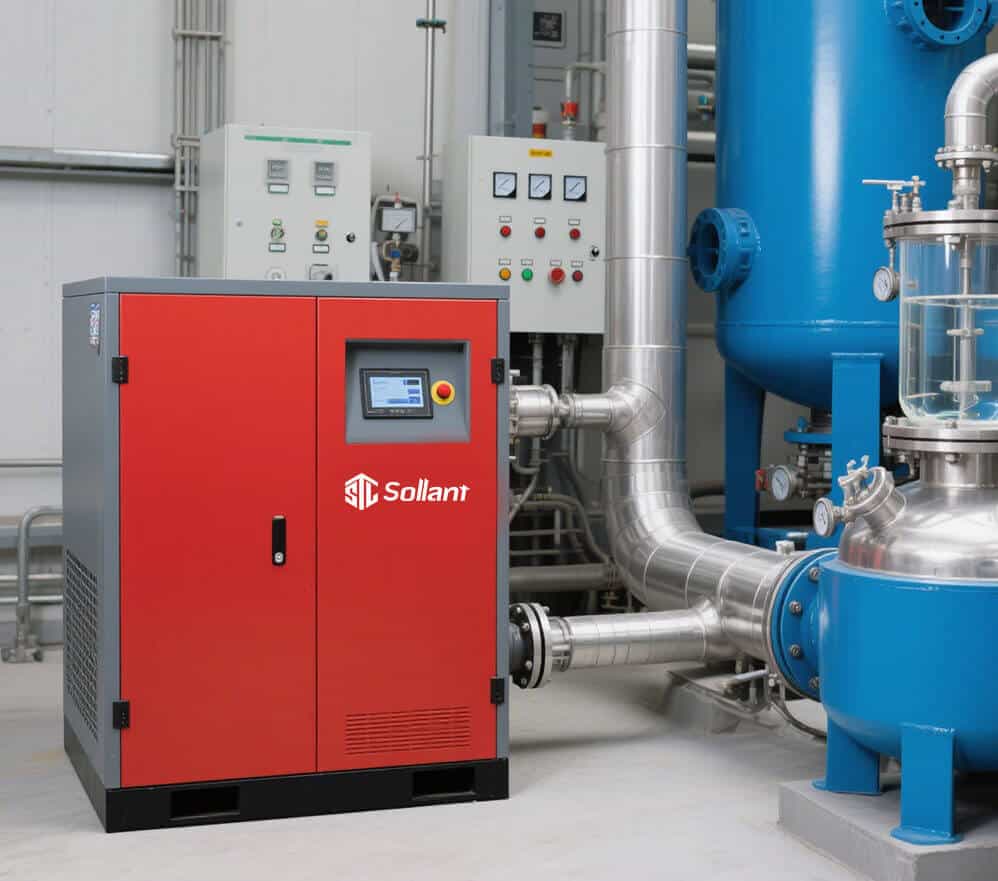
Why Choose Sollant Air Compressors?
As a professional manufacturer of air compressors, Sollant offers high-performance, customized compressed air solutions specifically tailored to meet the rigorous demands of the chemical industry:
- Safe and Reliable: Our products feature explosion-proof designs to ensure stable operation in flammable and explosive environments, thereby safeguarding the production process.
- Clean and Efficient: We offer both oil-lubricated and oil-free screw compressors (including water-lubricated, oil-free series) that meet Class 0 air purity standards, effectively preventing oil contamination from compromising the quality of chemical products.
- Energy-Efficient and Eco-Friendly: Utilizing advanced technologies—such as permanent magnet variable frequency drives and two-stage compression—our systems deliver significant energy savings, helping enterprises reduce operating costs by over 30%.
- Stable and Durable: The compressor air-ends feature high-precision rotors and premium-grade materials that are resistant to high temperatures and corrosion, making them ideal for the continuous production requirements of the chemical industry. Furthermore, our intelligent control systems enable remote monitoring, thereby minimizing maintenance-related downtime.
- Comprehensive Support: Our product range covers a wide spectrum of power outputs—from 7.5 kW to 315 kW—and offers various models, including fixed-speed, variable-frequency, and portable units. We also provide integrated solutions that include essential air treatment equipment, such as dryers, air receivers, and filters.
Sollant air compressors have been extensively validated across industries such as chemicals and petrochemicals. Through their exceptional performance and reliable service, they have empowered numerous enterprises to boost production efficiency, reduce energy consumption, and ensure safe manufacturing operations.

Related Products


Request a Quick Quote Now
Order or No Order? We're here for you 24/7

