
How do you choose the assist gas for a laser cutting machine? Nitrogen, oxygen, or compressed air?
In laser cutting, assist gas is not merely an optional accessory; it is a critical parameter that directly influences cutting speed, cut-edge quality, the heat-affected zone (HAZ), the degree of oxidation at the cut, and overall processing costs. For most factories, the real challenge lies not in whether to use gas, but in selecting the right type to achieve the optimal balance between quality and cost.
The three most common assist gases used in laser cutting machines are nitrogen, oxygen, and compressed air. Each is suited to specific materials, thicknesses, precision requirements, and cost targets. A correct choice can improve yield rates and reduce the need for post-processing, whereas an incorrect choice may lead to issues such as dross adhesion, discoloration, and increased burring—or even compromise equipment stability and production throughput.
What is laser cutting?
Laser cutting is a machining process that uses a high-power-density laser beam to irradiate a workpiece, causing the material to rapidly melt, vaporize, or reach its ignition point. Simultaneously, an assist gas flowing coaxially with the beam blows away the molten material, thereby achieving the cut.
Advantages of laser cutting:
- High precision: Narrow kerf (typically 0.1–0.3 mm) and minimal dimensional error, making it suitable for cutting complex shapes.
- High efficiency: Non-contact processing with no tool wear, ideal for mass production.
- Broad material compatibility: Suitable for both metals (carbon steel, stainless steel, aluminum, copper) and non-metals (plastics, wood, fabrics).
- Eco-friendliness and automation: Integration with CNC systems enables intelligent nesting and high material utilization.
The critical role of assist gas in laser cutting:
- Clearing molten material: Prevents slag from re-solidifying in the cut or on the underside, which would otherwise form burrs.
- Cooling and protection: Reduces the heat-affected zone (HAZ) and prevents material deformation or cracking.
- Controlling chemical reactions: Inert gases (e.g., nitrogen) prevent oxidation, while active gases (e.g., oxygen) promote exothermic reactions to accelerate cutting.
- Protecting the optical system: High-pressure gas blows away smoke and debris, extending the lifespan of the nozzle and protective lens.
- Enhancing cut quality: Influences cut perpendicularity, smoothness, surface color, and suitability for subsequent processing.
Without assist gas, laser cutting efficiency drops significantly, cut quality suffers, and cutting thick plates may become impossible. Common assist gases include nitrogen (N2), oxygen (O2), and compressed air is also used in some applications. Next, we will analyze the characteristics and working principles of these three mainstream gases in detail.
Analysis of the Characteristics and Working Principles of Three Common Assist Gases
1. Nitrogen (N2) — The Preferred Choice for Inert Protection
Nitrogen is the most widely used assist gas in laser cutting, particularly suitable for applications requiring high-quality cut edges. Its primary characteristic is chemical inertness (it barely reacts with metals).
Working Principles:
- Physical Purging: High-pressure nitrogen (typically 10–30 bar or higher) is ejected at high speed to completely blow molten metal out of the kerf.
- Oxidation Prevention: It isolates the metal from atmospheric oxygen, preventing the high-temperature metal from reacting with oxygen to form oxides. The cut edge presents a bright, silvery, and clean finish, eliminating the need for extensive post-processing.
- Cooling Effect: Nitrogen has a high heat-absorption capacity; it rapidly lowers the temperature at the cut zone, thereby reducing thermal deformation.
Applicable Scenarios:
- Materials prone to oxidation, such as stainless steel, aluminum alloys, and copper.
- Thin to medium-thickness plates (typically <12–20 mm, depending on laser power).
- Workpieces requiring high precision, an oxide-free finish, and subsequent processing such as welding, coating, or plating.
Advantages:
- Superior cut quality: smooth, burr-free, and free from discoloration.
- High cutting speeds on thin stainless steel sheets.
- Preserves the material’s original properties (e.g., the corrosion resistance of stainless steel).
Disadvantages:
- Higher cost (especially for liquid nitrogen or high-purity nitrogen).
- Cutting thick plates requires higher pressure and flow rates, resulting in high consumption.
- Sensitivity to purity (purity >99.99% is recommended).
When cutting stainless steel with nitrogen, insufficient purity can lead to slight oxidation, affecting both appearance and performance.
Learn more about nitrogen generators for laser cutting.
2. Oxygen (O2) — Accelerating Cutting via Exothermic Reaction
Oxygen is the traditional choice for cutting ferrous metals like carbon steel; its high reactivity is its key advantage.
Working Principle:
- Exothermic Reaction: Oxygen reacts with high-temperature iron/carbon steel to form oxides (such as FeO), releasing significant heat (providing 40–60% of the total energy). This creates a synergistic effect combining laser energy with combustion.
- Purging and Oxidation: It blows away molten slag but leaves an oxide layer on the cut edge.
- High Efficiency at Low Pressure: Efficient cutting is typically achieved at pressures of just 1–4 bar.
Suitable Applications:
- Medium-to-thick carbon steel plates (over 6mm, up to 20–50mm).
- Applications where edge color and the presence of an oxide layer are not critical (e.g., structural components requiring subsequent grinding).
Advantages:
- High cutting speed, especially for thick plates.
- Low gas cost.
- Strong penetration capability; suitable for thick materials.
Disadvantages:
- Cut edges may show oxidation, blackening, or slag adhesion, requiring post-processing.
- Not suitable for stainless steel (severe oxidation compromises corrosion resistance).
- Prone to over-burning on thin sheets; precision is slightly lower.
When cutting carbon steel with oxygen, the heat of the reaction significantly boosts efficiency, though the resulting oxide layer may affect welding quality.
3. Compressed Air — An Economical and Practical Assist Gas Solution
Supplied by an air compressor, compressed air consists of approximately 78% nitrogen, 21% oxygen, and other gases, making it the lowest-cost option.
Working Principle:
- Mixing Effect: Nitrogen provides partial inert protection, while the small amount of oxygen generates a mild exothermic reaction.
- Purging-Dominant: High-pressure air (typically 10–25 bar) forcefully blows away molten slag.
- Economical Cooling: Combines physical purging with a mild chemical reaction.
Suitable Applications:
- Thin sheets (<6–8 mm) of carbon steel, stainless steel, and aluminum.
- Parts with low surface finish requirements, intended for subsequent painting or simple processing.
- Cost-sensitive small and medium-sized enterprises (SMEs).
Advantages:
- Very low cost (primarily electricity).
- Cutting speeds on thin sheets can match or exceed those achieved with nitrogen.
- Convenient supply; no need for frequent gas cylinder changes.
Disadvantages:
- Cut edges may exhibit slight oxidation, discoloration, or minor burrs.
- High air quality requirements (must be dry and filtered to avoid contaminating the optical system).
- Poor performance on thick plates; increased burr formation.
Summary Comparison of the Three Gases :
- Nitrogen: Best quality, high cost, prevents oxidation.
- Oxygen: Fastest speed (thick carbon steel), low cost, causes oxidation.
- Compressed Air: High cost-effectiveness, suitable for thin sheets, moderate quality.
Comparison of Core Material Selection
The choice of assist gas depends primarily on the material. Different metals exhibit varying sensitivities to oxidation, heat input, and cut quality; therefore, selection should not be based solely on gas cost but must also take into account material properties and downstream processing requirements.
| Material Type | Common Gas Choices | Reasons for Suitability | Notes/Considerations |
| Carbon steel | Oxygen is preferred; air can be used as an alternative | Oxygen supports combustion, increasing cutting speed and the capacity to cut thicker plates | The cut edge is prone to oxidation and appears dark in color |
| Stainless steel | Nitrogen is preferred; air may be used for less demanding applications. | Nitrogen reduces oxidation and yields cleaner cut edges. | Nitrogen entails higher costs and strict purity requirements. |
| Aluminum alloy | Nitrogen or air, depending on thickness and requirements | Oxidation and dross must be controlled | High material reflectivity; narrower process window |
| Galvanized sheet | Air or nitrogen commonly used | Balances efficiency and surface quality | Consider the impact of fumes, dross, and coatings |
| Thin sheet metal parts | Air or nitrogen | Suitable for batch production and cosmetic parts | Depends on post-processing requirements |
| Parts with high aesthetic requirements | Nitrogen | Achieves superior cut-edge quality | Higher cost, but better overall return |
For carbon steel, oxygen is typically the preferred choice as it significantly boosts cutting efficiency—an advantage that is particularly pronounced when cutting thick plates.
For stainless steel, nitrogen is more commonly used, as it prevents significant oxidation and yields a higher-quality cut surface.
For thin-gauge parts where low costs are prioritized and cut quality requirements are moderate, compressed air is an increasingly common and practical solution.
Key Parameters Influencing Gas Selection
When selecting an assist gas, one should not focus solely on the gas type itself but must also consider the following key parameters:
1. Material Thickness
Greater thickness places higher demands on the assist gas’s purging capability and heat input control. Cutting thick plates often relies more on the combustion-supporting effect of oxygen, whereas stable cutting of thin plates is more easily achieved using nitrogen or air.
2. Cut Quality Requirements
If the product requires a high-quality finish, minimal burrs, low oxidation, and reduced post-processing, nitrogen is usually the better choice. If the primary requirement is simply cutting through the material—and subsequent grinding or coating is permissible—oxygen or air may be more economical.
3. Production Throughput
High-output factories place great importance on the number of parts produced per hour. Oxygen is often suitable for scenarios prioritizing speed, while nitrogen is better suited for those prioritizing quality; air is frequently used to strike a balance between cost and efficiency.
4. Overall Processing Costs
The price of the gas itself is only one component of the cost; factors such as post-processing, rework, scrap rates, and equipment maintenance must also be considered. Although the per-use cost of nitrogen is higher, it can prove more cost-effective in demanding applications if it reduces the need for grinding, cleaning, and rework.
5. Gas Supply System Capabilities
If a company intends to use compressed air for cutting, the quality of that air is critical. Oil, moisture, and dust in the air can compromise lens longevity, cutting stability, and the quality of the cut edge; therefore, the air compressor, refrigerated dryer, precision filters, air storage tank, and condensate drainage system must all be properly configured.
Precautions for Compressed Air Cutting
Using compressed air is not simply a matter of “plugging in a hose”; success hinges on gas quality:
- Absolute purity is paramount: If the compressed air contains moisture, oil mist, or dust, it will directly contaminate the cutting head’s protective lens, causing it to burn out; it can also clog the nozzle, severely compromising cutting quality or even leading to cutting failure.
- A high-efficiency purification system is essential: This must include a high-quality refrigerated dryer (or desiccant dryer) and multi-stage precision filters (for oil and dust removal) to ensure the compressed air meets high-grade ISO 8573-1 standards (e.g., a dew point of ≤-40°C and an oil content of ≤0.01 mg/m³).
- Adequate air pressure and flow are required: Particularly for high-power laser cutting (in the 10kW+ range), high-capacity air compressors and booster units are necessary to ensure a continuous, stable, high-pressure airflow (e.g., 3–3.5 MPa) at the cutting head.
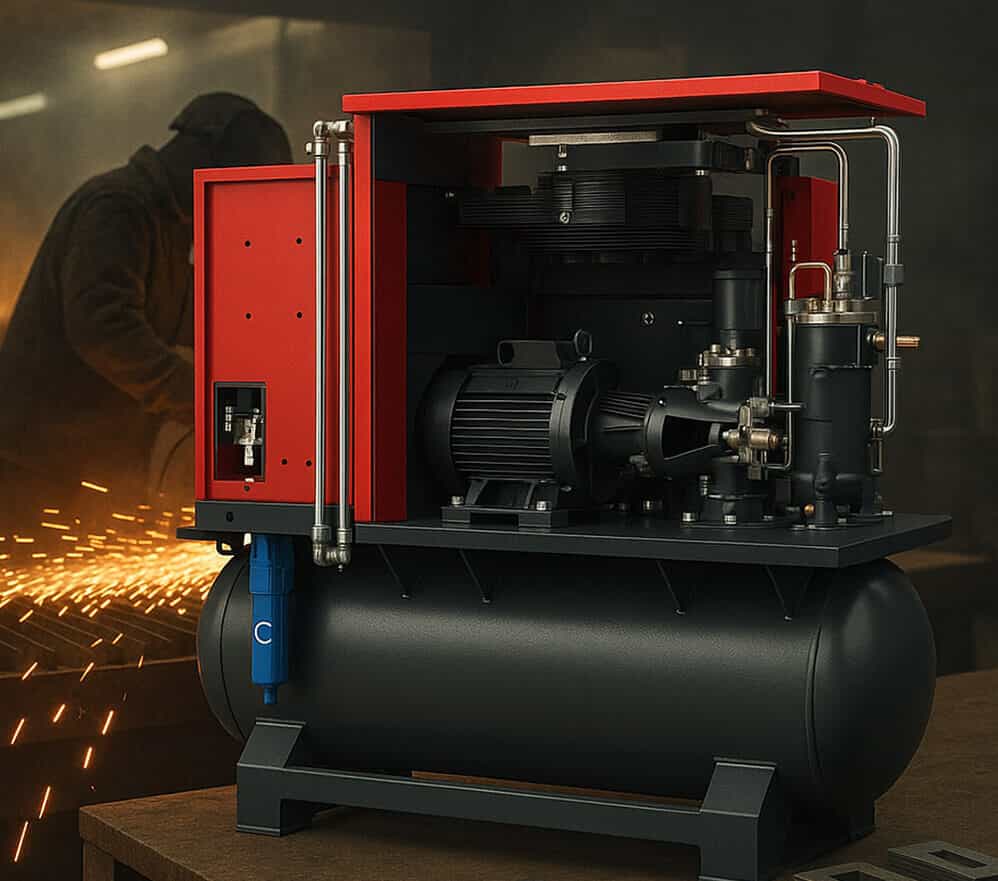
A large machinery manufacturing plant uses the Sollant SLTI-15 air compressor—specifically designed for laser cutting—for its sheet metal cutting operations. Since adopting this product, cutting quality has improved by 30%, and maintenance costs have been reduced by 50%.
Sollant One-Stop Gas Supply Solutions: Tailored for Laser Cutting
As a professional manufacturer with years of expertise in the air compressor industry, Sollant deeply understands the rigorous demands laser cutting places on gas supply quality and stability. To meet these needs, we have launched a comprehensive product line specifically designed for laser cutting applications, including specialized air compressors, nitrogen generators, and oxygen generators. Unlike standard air compressors, Sollant’s specialized units feature integrated, high-efficiency purification systems that remove moisture, oil, and dust. This ensures the compressed air consistently meets quality standards, effectively eliminating the risks of lens contamination and nozzle clogging at the source. Meanwhile, our nitrogen and oxygen generators utilize advanced Pressure Swing Adsorption (PSA) technology to provide a continuous on-site supply of high-purity nitrogen (up to 99.999%) and industrial-grade oxygen (over 99.5%), allowing customers to completely eliminate the high costs associated with gas cylinder procurement and logistics. From individual units to complete gas supply systems, Sollant is dedicated to providing every laser cutting user with stable, pure, and cost-effective integrated gas supply solutions.
Conclusion
There is no absolute standard for selecting assist gases for laser cutting machines; the choice requires a balanced assessment of factors such as material type, thickness, quality requirements, budget, and downstream processing needs. Nitrogen delivers superior cut quality, oxygen excels at the efficient cutting of thick carbon steel, and compressed air is the most cost-effective choice for thin sheets. By optimizing gas supply systems, fine-tuning parameters, and ensuring regular maintenance, enterprises can significantly reduce costs and enhance their competitiveness.
It is recommended to start with small-scale tests, recording data on cutting speed, quality, and cost for different gases to gradually build a proprietary process database. As technology advances, on-site gas generation and intelligent gas control systems will further lower the barriers to adoption. Selecting the right gas is not merely a technical decision but a strategic move to boost manufacturing competitiveness.
Request a Quick Quote Now

Shandong Sollant Machinery Manufacturing Co., Ltd.
20 years of professional export experience. Our twin-screw air compressor is very popular in the international market.
