
Oil-Free Air Compressors in Electronics Manufacturing
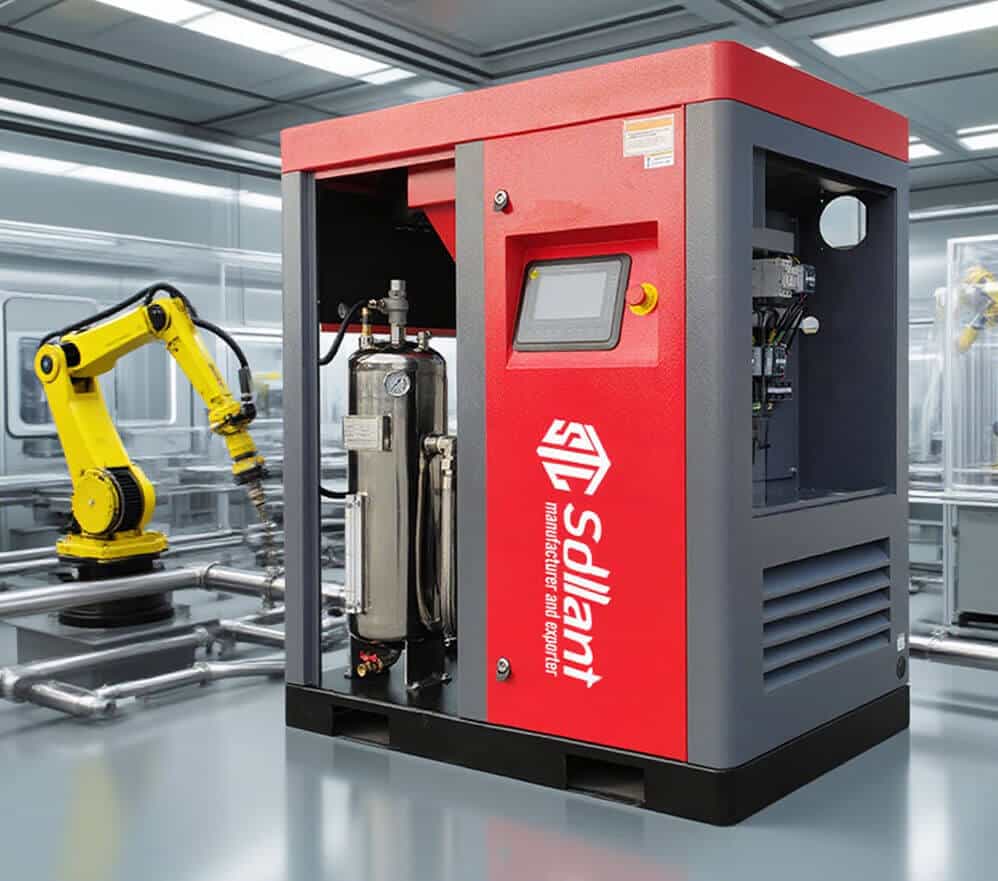
A single batch of contaminated PCBs can cost a mid-size electronics factory tens of thousands of dollars in scrap, rework, and customer returns. In most cases, the root cause is not a design flaw or a worker error — it is oil-contaminated compressed air silently degrading product quality across every shift. If your compressed air system is not built around an oil-free air compressor, you are accepting a risk that no electronics operation can afford.
This article breaks down why oil-free compression is a non-negotiable standard in electronics manufacturing, how to size and select the right system, and what separates a reliable long-term investment from an expensive mistake.
Why Electronics Manufacturing Cannot Tolerate Oil Contamination
Electronic components operate at tolerances measured in microns. A PCB trace, a BGA solder joint, a MEMS sensor cavity — these structures are destroyed not by heavy-duty abuse, but by microscopic contamination that a human eye cannot detect on the production line.
Compressed air touches nearly every stage of electronics manufacturing:
- Component placement and SMT assembly:air jets position and hold components during soldering
- Conformal coating application:spray nozzles atomize protective coatings over circuit boards
- AOI and X-ray inspection:pneumatic stages move boards through inspection systems
- Wave soldering and reflow:nitrogen and air blankets control oxidation during thermal processes
- Board cleaning and defluxing:high-pressure air removes flux residue and particulates
- Packaging and handling:vacuum cups and air cylinders move finished units
When any of these air streams carries trace oil — even at concentrations as low as 0.01 mg/m³ — the consequences compound. Oil on a PCB surface disrupts adhesion in conformal coating, causes solder balling during reflow, and leaves ionic residues that accelerate electrochemical migration. In cleanroom environments, even aerosolized oil particles trigger particle count violations that shut down production entirely.
The damage is rarely visible at the moment of contamination. It surfaces as field failures, warranty claims, and customer churn months later.
Oil-Lubricated vs. Oil-Free Air Compressors: A Direct Comparison
The argument for oil-free compression in electronics is not simply about preference — it is about what the technology can and cannot guarantee.
Oil-lubricated rotary screw compressors use oil to cool, seal, and lubricate the compression element. Even with multi-stage downstream filtration, oil carry-over cannot be eliminated to zero.Filters degrade. Coalescers saturate. A missed service interval or a filter bypass condition exposes the entire production process to contamination.
Oil-free air compressors — whether water-injected screw, dry screw, scroll, or centrifugal — remove oil from the compression cycle entirely. There is no carry-over to filter out.
| Feature | Oil-Lubricated Compressor | Oil-Free Air Compressor |
| Air purity ceiling | ISO 8573-1 Class 1 (with filtration) | ISO 8573-1 Class 0 (certified) |
| Oil carry-over risk | Always present; depends on filter condition | Zero by design |
| Filter dependency | Critical — failure = contamination | Minimal downstream filtration required |
| Maintenance complexity | Higher — oil changes, filter replacements, separator service | Lower — no oil system to maintain |
| Typical purchase cost | Lower upfront | 30–50% higher upfront |
| 5-Year Total Cost of Ownership | Often higher when oil, filters, and waste disposal are factored | Lower or comparable when energy and consumables are included |
| Suitability for cleanroom | Not recommended | Standard requirement |
| Compliance with ISO 8573-1 Class 0 | Cannot achieve | Achievable with certified equipment |
The 30–50% higher upfront cost of an oil-free air compressor is typically recovered within 2–3 years through reduced filter costs, lower energy consumption with variable-speed models, and elimination of contamination-related production losses.
For a deeper look at reliability issues: [5 Common Problems in Oil-Free Air Compressors and How to Fix Them]
Understanding ISO 8573-1 Class 0 — The Standard That Actually Matters
Most electronics manufacturers know they need “clean air.” Fewer understand what that means in precise, auditable terms.
ISO 8573-1 is the international standard that defines compressed air purity across three contaminant categories: solid particles, water (liquid and vapor), and total oil content. The classification runs from Class 1 (cleanest measurable) to Class 6 (least clean), with Class 0 defined as stricter than any other class — meaning the user specifies the maximum acceptable level and the equipment must be certified to meet it.
For electronics manufacturing, Class 0 oil content (< 0.01 mg/m³) is the baseline requirement in most semiconductor, PCB, and precision assembly environments. It is also the standard required by major OEM qualification programs from brands including Samsung, Foxconn, and their tier-1 suppliers.
Key purity requirements by electronics process:
| Process | Solid Particle Class | Moisture Class | Oil Class |
| SMT Assembly | Class 2 | Class 4 | Class 0 |
| Conformal Coating | Class 2 | Class 3 | Class 0 |
| Cleanroom / ISO 5–7 | Class 1 | Class 2 | Class 0 |
| Board Cleaning | Class 2 | Class 4 | Class 0 |
| Packaging / Handling | Class 3 | Class 4 | Class 1 |
What this table makes clear: oil purity Class 0 is not a premium specification — it is the minimum for contact-critical processes. Any system that cannot guarantee Class 0 is structurally incompatible with modern electronics production requirements.
How to Size an Oil-Free Compressed Air System for an Electronics Facility
Selecting the right oil-free air compressor is not about picking the largest available unit. Oversizing wastes energy and creates pressure fluctuations that destabilize precision processes. Undersizing causes pressure drops that stall pneumatic actuators and disrupt automated production lines.
A correctly sized system starts with a load audit, not a catalog.
Step 1: Map all air-consuming equipment
List every pneumatic device in the facility — SMT machines, pick-and-place units, conveyors, robots, cleaning systems, test fixtures — and record the rated air consumption (CFM or L/min) and required operating pressure (bar or PSI) for each.
Step 2: Calculate peak simultaneous demand
Not all equipment runs at full load simultaneously. Apply a utilization factor (typically 0.6–0.8 for electronics assembly lines) to get realistic peak demand. Add a 20–25% safety margin for future expansion and demand spikes.
Step 3: Determine pressure requirements
Most electronics manufacturing pneumatic systems operate between 5–7 bar (72–100 PSI). Identify the highest-pressure requirement and size the system to that ceiling, using pressure regulators at each point of use to step down as needed.
Step 4: Evaluate variable-speed drive (VSD) compressors
Electronics assembly lines run in shifts with variable production schedules. A fixed-speed compressor running at 100% capacity during slow periods wastes significant energy. VSD oil-free air compressors adjust motor speed to match real-time air demand, reducing energy consumption by 20–35% in facilities with variable load profiles.
Step 5: Plan for redundancy
A single-compressor system is a single point of failure. For any production environment where downtime costs exceed a few thousand dollars per hour, a lead-standby configuration — two compressors where either can carry full load — is the standard engineering recommendation.
Common Mistakes Electronics Manufacturers Make When Specifying Compressed Air Systems
The specifications look correct on paper. The equipment arrives on time. Production begins. And six months later, a contamination event triggers a customer audit. These are the decisions that lead there.
Mistake 1: Ignoring pressure dew point
Oil-free air is clean air — but clean air that carries moisture will cause corrosion in pneumatic actuators, bubble formation in conformal coatings, and condensation in cleanroom environments. An oil-free air compressor must be paired with a correctly sized refrigerated or desiccant dryer to achieve both oil-free and moisture-controlled output. The dew point target for most electronics assembly environments is -20°C to -40°C pressure dew point.
Mistake 2: No air receiver storage
Compressed air systems with inadequate receiver tank volume experience rapid pressure cycling — the compressor starts and stops frequently, wearing the motor and creating pressure fluctuations at point of use. A receiver sized at 6–10 times the compressor’s CFM output per minute is a standard starting point for electronics facilities. The receiver also serves as a buffer during peak demand events.
Mistake 3: No leak detection program
Studies across industrial compressed air users consistently show that compressed air system leaks account for 20–30% of total compressed air production. In an electronics facility where air quality must be maintained at Class 0, an undetected leak in an aged fitting or a damaged connector introduces uncontrolled ambient air — with its particulates and humidity — directly into a clean system. Quarterly ultrasonic leak surveys are a minimum standard.
Mistake 4: Treating compressed air as a utility, not a process input
Water and electricity in a factory have dedicated monitoring, backup systems, and quality control. Compressed air — which touches more production steps than either — is often managed reactively. Building compressed air into your facility’s quality management system (QMS), with defined purity specifications, scheduled audits, and documented maintenance records, is not optional for electronics manufacturers seeking OEM certification.
What to Look for in an Oil-Free Air Compressor Supplier
The compressor itself is one part of the decision. The supplier relationship determines whether the system performs as promised over a five- to ten-year operating life.
When evaluating oil-free air compressor suppliers for electronics manufacturing applications, prioritize:
- Certified Class 0 documentation:The supplier must provide third-party verified ISO 8573-1 Class 0 certification for the specific compressor model, not a general brand claim. Ask for the test report, not just the spec sheet.
- Application engineering support:A supplier who can conduct a compressed air audit, calculate system demand, and design a complete system — compressor, dryer, filtration, pipework, receiver — delivers a lower risk outcome than one who ships equipment and leaves system design to the buyer.
- After-sales service infrastructure:Oil-free air compressors require specialized maintenance by technicians trained on oil-free technology. Confirm service response times, spare parts availability, and whether the supplier has local or regional technical coverage for your facility location.
Sollant manufactures oil-free air compressor and oil-injected rotary screw compressors designed for demanding industrial environments, including electronics manufacturing. The product range includes VSD oil-free air compressors, integrated dryer units, and complete compressed air system packages for factory deployment.
Explore the full product range: Sollant Oil-Free Air Compressors
Conclusion
- Oil-free air compressors are not an upgrade option in electronics manufacturing — they are the baseline requirement. ISO 8573-1 Class 0 certification is the specification that aligns with OEM qualification standards, cleanroom protocols, and quality management requirements across the global electronics supply chain.
- Total cost of ownership favors oil-free systems over a 3–5 year horizon. The higher upfront investment is offset by lower consumables costs, reduced contamination risk, and the ability to meet customer audit requirements that oil-lubricated systems structurally cannot satisfy.
- System design matters as much as equipment selection. The right compressor paired with an undersized dryer, no receiver, or a neglected leak detection program will still produce quality failures. A complete system approach — compressor, air treatment, piping, monitoring, and maintenance protocol — is what protects production uptime and product quality.
Request a Quick Quote Now

Shandong Sollant Machinery Manufacturing Co., Ltd.
20 years of professional export experience. Our twin-screw air compressor is very popular in the international market.
