
How Can an Air Compressor Enhance Your Woodworking Projects?
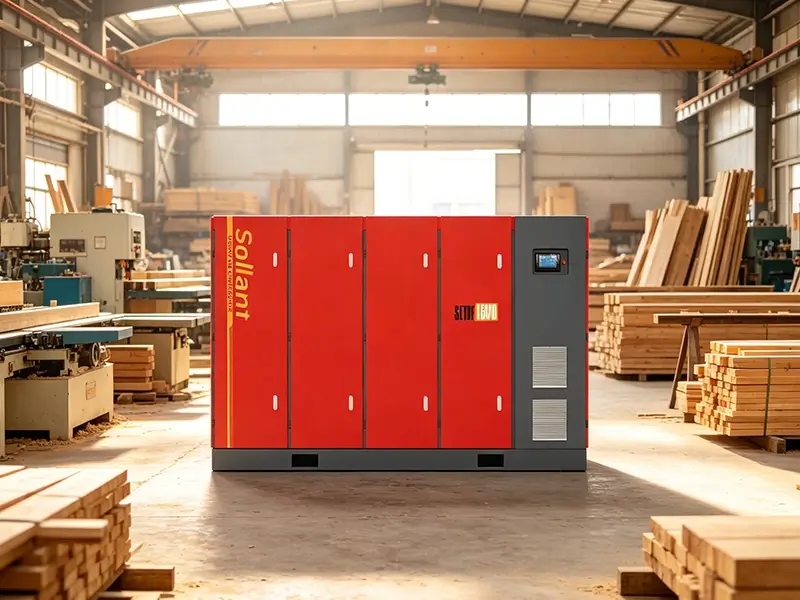
What most woodworking shops don’t like to talk about:
You line up a whole batch for finishing. Halfway through, the spray gun starts spitting. The nail gun gets choppy and keeps sticking. Next thing you know, production slows to a crawl, the shift runs late, and the rework pile is a mess.
The tools themselves are fine. The real problem is the air feeding them.
Pick an undersized air compressor or spec it wrong, and it doesn’t just slow you down — it messes up quality all the way down the line. This guide walks you through where compressed air actually matters in a woodshop, which specs really count, and how to stop leaking efficiency because of air problems. For good.
Why the Air Compressor Is the Real Engine of a Woodworking Shop
Most operators think of the air compressor as background equipment — something that lives in the corner and runs the tools. That framing is wrong, and it leads to the most common and expensive specification mistakes in the industry.
In a production woodworking environment, compressed air is load-bearing infrastructure. Every pneumatic tool, every spray line, every CNC vacuum table, and every dust management system depends on a continuous, clean, pressure-stable supply of compressed air. When that supply fails — even partially — the impact cascades across the entire shop floor.
Consider the numbers: an orbital sander requires 6–9 CFM at 90 PSI. A single HVLP spray gun demands 9–18 CFM. Running three of either simultaneously without an air compressor specified for that peak demand means every tool in the shop is running below its rated performance level.
The result isn’t just slower work. It’s uneven sanding that shows up in the finish. It’s underpowered nail guns that drive fasteners 2mm short. It’s spray patterns that break down mid-coat and leave texture inconsistencies across the entire panel surface.
The air compressor is not a supporting character. It is the system.
[Related article: Top 5 Reasons Why Air Compressor Placement Environment Matters for Performance and Longevity]
The 5 Stages of Woodworking Where Compressed Air Is Non-Negotiable
Compressed air touches every step of the wood products production chain. Understanding what each stage demands — in pressure, flow rate, and air quality — is the foundation of any correct specification decision.
Stage 1: Log Processing and Sawmill Operations
At the industrial end of the woodworking spectrum, a sawmill’s compressed air system is typically the facility’s single largest electricity consumer. Most sawmill operations require continuous compressed air capacity — a scale that immediately rules out any reciprocating or small rotary screw solution.
Pneumatic controls govern log kickers, sorting gates, and the automated routing systems that move lumber through the mill at production speed. A pressure drop doesn’t slow the process — it stops it. In cold-climate operations, water vapor in the air lines presents an additional threat: frozen actuators and corroded valve bodies are the direct consequence of inadequate moisture management.
Oil-flooded rotary screw air compressors operating at 100% duty cycle, paired with desiccant drying systems capable of reaching −40°F pressure dew point, are the correct specification at this scale.
Stage 2: Framing, Nailing, and Assembly
Pneumatic framing nailers, brad nailers, and staplers are the backbone of cabinet, panel, and furniture assembly lines. They drive faster than electric alternatives, reduce repetitive strain across an eight-hour shift, and deliver consistent fastening force that manual methods cannot replicate at production speed.
The critical variable is consistent delivery pressure. A framing nailer operating at 90 PSI that drops to 72 PSI mid-cycle will underdrive fasteners — creating structural failures and rework that doesn’t show up until the piece is in a customer’s hands.
Typical demand: 70–120 PSI, 2–5 CFM per gun. The mistake most shops make is calculating for one gun and then adding three more to the line without revisiting the air compressor specification.
Stage 3: Sanding and Surface Preparation
Pneumatic orbital and straight-line sanders are preferred in production environments because they run cooler, are lighter to handle, and carry no electrical spark risk near finishing chemicals. However, they are among the highest CFM consumers in the shop.
A single orbital sander draws 6–9 CFM at 90 PSI. A straight-line sander can demand 8–12 CFM. Running three sanding stations simultaneously while the assembly line is also active will overwhelm an air compressor that wasn’t sized for peak concurrent demand.
The practical consequence: inconsistent disc speed across the shift, uneven material removal, and finish adhesion failures that only become visible after coating is applied.
Stage 4: Spray Finishing and Surface Coating
This is the stage where air quality becomes as critical as air quantity — and where the most expensive, least visible damage occurs when the specification is wrong.
Spray guns atomize lacquers, stains, primers, and waterborne coatings. Any oil or moisture carried in the compressed air stream will contaminate the finish directly. Oil-contaminated air causes fisheye defects. Moisture causes blushing, poor adhesion, and raised grain. Neither defect is visible when it happens. Both show up after the coating cures — after the workpiece has moved to the next station, sometimes after it has left the facility entirely.
Spray finishing requires:
- A refrigerated air dryer at minimum for solvent-based coatings
- A coalescing filter rated to less than 0.01 ppm oil content
- An activated carbon filter to remove oil vapor
- For waterborne coatings: an oil-free air compressor, not filtered oil-lubricated supply
Typical demand: 40–60 PSI at the gun, 9–18 CFM for HVLP systems. The air treatment system is not optional equipment. It is part of the finishing line.
Stage 5: CNC Machining and Vacuum Hold-Down
Modern CNC routers use vacuum pumps to hold panels flat against the spoil board during cutting operations. If vacuum hold-down pressure drops mid-pass, the workpiece shifts. The result: a scrapped panel at minimum, a safety incident if the piece is ejected.
Compressed air also drives tool changers, coolant delivery, and pneumatic clamping on most CNC platforms. Integrating CNC air demand into the general shop supply without dedicated pressure regulation and a buffer tank is a specification error that produces immediate, visible, and costly consequences.
Required: stable 80–100 PSI, dry and filtered air, isolated from high-draw tools with a dedicated regulator and receiver tank.
Air Compressor Types Compared: Matching the Machine to the Application
Selecting the wrong compressor type creates problems that no amount of correct usage can solve. The table below covers the three categories that apply to woodworking operations, mapped against the production contexts where each belongs.
| Compressor Type | Best Application | Duty Cycle | Typical Power Range | Key Limitation |
| Reciprocating piston | Small shops, intermittent nail guns, occasional sanding | 50–70% max | 1–30 HP | Not rated for continuous operation; overheats under sustained load |
| Rotary screw air compressor(oil-lubricated) | Production lines, sustained finishing runs, sawmills | 100% continuous | 5–500+ HP | Requires downstream filtration for finishing applications |
| Oil-free rotary screw air compressor / scroll air compressor | Waterborne coating lines, pharmaceutical-grade finishing | 100% continuous | 5–200 HP | Higher acquisition cost; mandatory for contamination-sensitive applications |
How to use this table: Identify your highest-demand scenario — typically a finishing run with spray guns and sanding stations running simultaneously. If that scenario runs for more than 2 hours continuously, reciprocating machines are eliminated regardless of their rated output. Map your peak concurrent CFM requirement to the appropriate machine category, then specify the air treatment system alongside it.
A variable speed drive (VSD) rotary screw air compressor is worth serious consideration for any production operation with variable daily demand patterns. VSD machines reduce energy consumption by 20–35% compared to fixed-speed equivalents by modulating output to match actual demand rather than cycling on and off at full capacity.
The Parameters That Actually Determine Whether Your System Works
Two numbers determine whether a compressed air system can do its job: pressure (PSI) and flow rate (CFM). Getting either wrong is expensive. The table below covers working ranges for the tools most common in woodworking production.
| Tool | Working PSI | CFM per Tool | Air Quality Required |
| Framing nailer | 70–120 | 2–4 | Standard |
| Brad / finish nailer | 60–100 | 1–2 | Standard |
| Orbital sander | 80–100 | 6–9 | Standard |
| Straight-line sander | 90 | 8–12 | Standard |
| HVLP spray gun | 25–50 (at gun) | 9–18 | Oil-free / filtered |
| Conventional spray gun | 40–60 | 5–14 | Oil-free / filtered |
| Air blow-off / dust clearing | 30–90 | 2–10 | Standard |
| CNC pneumatic controls | 80–100 | 4–8 | Dry / filtered |
How to calculate your required compressor output:
List every tool that could run simultaneously during your peak production scenario. Sum their CFM requirements. Multiply that total by 1.25 to account for line leakage and pressure drop across fittings and regulators. That number — not the nameplate output of your air compressor, but the actual delivery at the tools — is your minimum system requirement.
Do not size for average demand. Size for peak concurrent demand. A system that meets average demand will fail every time production accelerates.
For tank sizing: intermittent tools (nailers, staplers) benefit from 1 gallon of storage per CFM of compressor output. Continuous-draw tools (sanders, spray guns) need adequate sustained output — tank storage cannot compensate for insufficient air compressor capacity when demand is sustained.
The 5 Specification Mistakes That Cost More Than the Air Compressor
These are the errors that appear most consistently across woodworking facilities of every scale. Each one is preventable. Each one is more expensive to fix after installation than before.
Mistake 1: Sizing for average demand instead of peak demand
A shop running one nailer most of the day sizes for one nailer. When a full finishing run starts with two spray guns and two sanding stations active, the system collapses. The cost: production delays, quality failures, and frequently a second compressor purchase within 18 months.
Mistake 2: Running a reciprocating compressor continuously
Reciprocating machines are designed for intermittent use — typically 50–70% duty cycle. Running them continuously to meet sustained finishing demand causes overheating, accelerated valve wear, and premature failure. The repair costs over three years exceed the price difference between a reciprocating machine and a correctly specified rotary screw unit.
Mistake 3: Skipping air treatment for finishing applications
Oil contamination in compressed air at concentrations invisible to the eye is sufficient to cause finish defects across an entire production run. Fisheye, poor adhesion, and blushing all trace back to contaminated supply air. A coalescing filter rated to less than 0.01 ppm oil content is not optional equipment for any spray finishing application.
Mistake 4: Ignoring moisture in cold-climate installations
Water vapor in compressed air lines freezes at sub-zero temperatures, blocking actuators, cracking pneumatic valve bodies, and halting production in sawmills and outdoor processing facilities. Refrigerated dryers are insufficient below freezing ambient conditions. Desiccant drying is required.
Mistake 5: Integrating CNC supply into general shop air without isolation
When a high-demand tool draws down shop air pressure, CNC vacuum hold-down pressure drops simultaneously. The workpiece releases mid-cut. This produces scrapped panels and creates real safety risk for operators. CNC supply must be isolated with a dedicated pressure regulator and buffer receiver.
Maintenance Cadence and Operating Cost: What the Purchase Price Doesn’t Tell You
The purchase price of a compressed air system represents roughly 12–20% of its total cost of ownership over a ten-year service life. Energy consumption is the dominant cost driver — compressed air generation typically accounts for 30–40% of a production facility’s total electricity bill.
These maintenance intervals are not suggestions. They are the difference between a system that runs for 15 years and one that requires major rebuilds at year 6.
Daily:
- Drain condensate from tank and moisture separator
- Check operating pressure gauge against rated output
- Listen for audible air leaks at fittings and connections
Weekly:
- Inspect air/oil separator on rotary screw units
- Check belt tension and wear on reciprocating machines
- Clean or replace intake air filter if operating in a dusty environment
Quarterly:
- Replace coalescing and particulate filter elements
- Verify dew point output on dryer
- Log operating temperature trends for early fault detection
Annually:
- Commission a full system leak audit
- Oil change and separator element replacement on screw air compressors
- Safety valve function test
The highest-return maintenance activity in any compressed air system is the annual leak audit. Air leaks are silent, invisible, and nearly universal in unaudited facilities. A 1/8-inch leak at 100 PSI wastes approximately 25 CFM continuously — roughly the full output of a mid-size shop compressor running solely to compensate for leakage. Audited facilities consistently recover 15–25% of compressed air energy cost through leak detection and repair alone.
How to Specify a System That Actually Fits Your Operation
Before contacting any supplier, have clear answers to these questions. A supplier who does not ask them before recommending a system is selling from a catalog, not solving your problem.
- How many tools will run simultaneously at peak production, and what are their individual CFM and PSI requirements?
- What is your production duty cycle — how many hours per day at or near full demand?
- Do you have spray finishing applications? If yes: solvent-based or waterborne coatings?
- What is the minimum ambient temperature at the air compressor installation location?
- What electrical supply is available: single-phase or three-phase, and at what amperage?
- What are the space and noise constraints at the installation site?
- What is the full budget for the system — air compressor, dryer, filtration, piping, and installation — not just the compressor unit?
The total installed cost of a correctly specified system is nearly always lower than the total cost of correcting an incorrectly specified one over five years.
For operations looking to upgrade or build out a compressed air system matched to production woodworking demands, Sollant offers rotary screw and oil-free air compressor solutions sized for the full range of woodworking applications — from cabinet shop to industrial sawmill. More information is available at sollant.com.
Conclusion
Air quality matters as much as air quantity. An oil-free or properly filtered supply is not a premium upgrade for finishing applications — it is the baseline requirement. Contaminated air produces defects that cannot be corrected after the coating is applied.
Size for peak concurrent demand, not average demand. The scenario that breaks your system is not the average shift. It is the full finishing run with every station active simultaneously. Build your specification around that number, with a 25% safety margin for system losses.
The air compressor purchase is 12–20% of the ten-year cost. Energy consumption and maintenance dominate total cost of ownership. A VSD rotary screw air compressor with a proper air treatment system costs more at acquisition and consistently less over its service life than an undersized machine patched with downstream fixes.
Request a Quick Quote Now

Shandong Sollant Machinery Manufacturing Co., Ltd.
20 years of professional export experience. Our twin-screw air compressor is very popular in the international market.
