
How to Choose the Right Compressor for the Textile Industry?
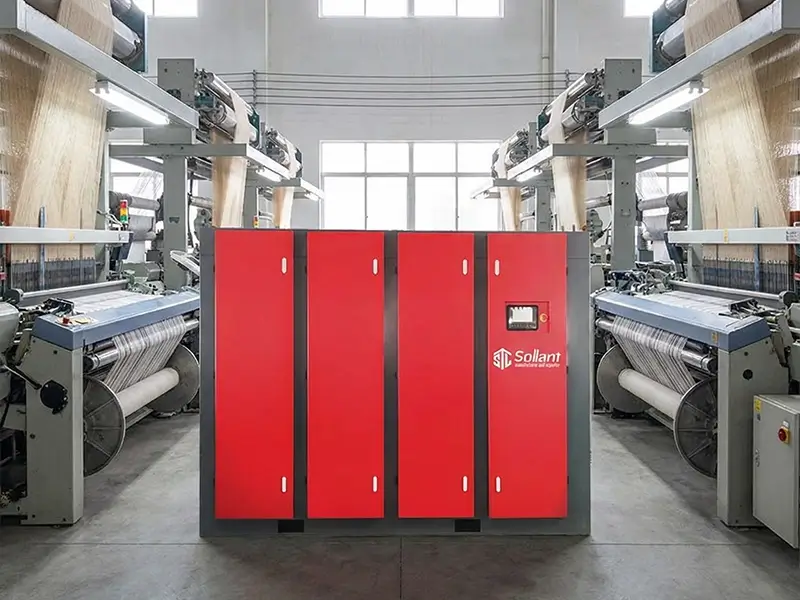
In the modern textile industry, compressed air is often referred to as the “fourth utility”—ranking alongside electricity, water, and fuel. From fiber manufacturing to garment processing, compressed air plays an integral role in every stage of production. However, the operating environment within textile mills is typically characterized by high temperatures, high humidity, and airborne fiber dust (fly), placing extremely rigorous demands on the performance of air compressors.
Selecting the appropriate compressor is not merely a matter of ensuring the stable operation of the production line; it also directly impacts the quality of the final product, energy consumption costs, and the company’s carbon footprint. This article will delve into how the textile industry can identify and select the compressed air system best suited to its specific process requirements, thereby empowering enterprises to achieve the dual objectives of energy conservation and efficient production.
Applications of Compressed Air in Textile Processing
The textile industry is a highly automated sector where the application of compressed air is extensive; consequently, the stability of its cleanliness, pressure, and flow rate directly impacts process quality.
1. Air Jet Looms
This constitutes the single largest area of compressed air consumption within the textile industry. Air jet looms utilize a high-velocity stream of compressed air to propel the weft yarn across the shed.
Requirements: Extremely high stability. Pressure fluctuations can lead to weft insertion failures, resulting in fabric defects or machine downtime.
Quality: The compressed air must be dry and oil-free; otherwise, oil contamination or moisture will stain the fabric surface, leading to costly rates of defective products.
2. Open-End Spinning
In open-end spinning, compressed air is employed for fiber transport, dust removal, and assisting in the yarn twisting process.
Requirements: Constant airflow and pressure are essential to ensure the uniformity of yarn count and tensile strength.
3. Pneumatic Transmission and Automation Control
Textile machinery—such as carding machines, draw frames, and roving frames—makes extensive use of pneumatic cylinders, valves, and sensors to execute precise movements and control operations.
Requirements: The air must be filtered to prevent impurities from causing abrasive wear on precision pneumatic components.
4. Humidification and Dust Removal
Textile workshops require the maintenance of specific humidity levels to preserve fiber resilience. Compressed air is frequently used to power spray-based humidification systems. Additionally, it is utilized to purge machinery of lint and dust, thereby mitigating fire hazards and preventing mechanical malfunctions.
5. Dyeing and Finishing Processes
During the fabric post-processing stage, compressed air is used to actuate valves on dyeing machines, as well as to facilitate fabric setting and coating processes.
Key Factors to Consider When Selecting a Compressed Air System for Textile Applications
In the textile industry, the selection of air compressors must not focus solely on purchase price or power output (kW); rather, it requires a thorough evaluation of the following five core dimensions to ensure both production efficiency and safety.
1. Airflow Requirements
Air consumption in textile mills is typically substantial and subject to significant fluctuations. When assessing airflow requirements, one cannot simply aggregate the rated air consumption figures of all individual pieces of equipment. Engineers must instead calculate the peak and average airflow demands for all air-jet looms, spinning machines, and pneumatic components. Since not all equipment operates at maximum load simultaneously, a simultaneity factor—typically ranging from 80% to 90%—is generally applied. Furthermore, to account for long-distance transmission through the piping network and inevitable minor leaks, a redundancy margin of 10% to 15% should be built into the selection process to ensure that system pressure remains stable and does not collapse during any peak demand periods.
2. Pressure Demands
Pressure stability is the “lifeline” of textile quality. Air-jet looms typically require a continuous and stable pressure ranging from 0.5 MPa to 0.8 MPa. If the air supply pressure fluctuates by more than 0.02 MPa, it will significantly increase the yarn breakage rate and reduce production efficiency. When selecting equipment, it is essential to evaluate the compressor’s ability to maintain constant pressure under varying load conditions. Furthermore, it is necessary to calculate the terminal pressure drop occurring as the air passes through refrigerated dryers, precision filters, and hundreds of meters of transmission piping, thereby ensuring that the pressure reaching the loom end still meets the required process standards.
3. Air Quality
In the textile industry, air quality directly determines the grade of the fabric produced. According to the ISO 8573-1 standard, critical process stages typically require an oil-free standard of Class 0. This is because compressed air comes into direct contact with the yarn; even trace amounts of oil droplets can form indelible oil stains on the fabric. Particularly during the dyeing and printing stages, these contaminants can create dye-resistant spots, resulting in large batches of defective products. Additionally, moisture in the air must be effectively removed using refrigerated dryers or desiccant dryers; failure to do so can lead to corrosion of pneumatic components and cause cotton fibers within the workshop to clump together, thereby clogging the precision nozzles of the looms.
4. Energy Efficiency
Since textile mills typically operate continuously around the clock, electricity costs account for over 80% of a compressor’s total lifecycle cost. The key metric for measuring energy efficiency is specific power—the amount of electrical energy consumed to generate one cubic meter of compressed air. Screw compressors utilizing two-stage compression technology achieve approximately 15% higher efficiency than single-stage models at the same power output. Furthermore, models equipped with Permanent Magnet Variable Frequency Drive (VFD) technology can automatically adjust their motor speed based on actual air demand. This eliminates the idle power consumption associated with frequent loading and unloading cycles, resulting in particularly significant energy savings in facilities with highly fluctuating air requirements.
5. Durability in Dusty Environments
Textile workshops represent one of the most demanding environments in the industrial sector, with the air constantly laden with airborne cotton lint and fine fibers. The cooling fins on standard compressors are highly susceptible to becoming clogged with lint, which can lead to overheating shutdowns or even permanent damage to the machine. Consequently, compressors specifically designed for the textile industry must feature heavy-duty air intake filters and coolers with wide-pitch fin designs; in some cases, the installation of specialized dust-proof filter cabinets is also required. The electrical control system must also possess a high degree of ingress protection to prevent conductive fibers from entering electrical components and triggering short-circuit faults.
Types of Compressors Used in the Textile Industry
Currently, the mainstream compressor models available on the market each possess their own respective strengths and weaknesses; however, a haphazard configuration of these units serves as the root cause of energy consumption issues within textile mills.
| Model Type | Working Principle | Advantages | Disadvantages | Applicable Scenarios |
| Oil-Injected Screw Air Compressor | Relies on lubricating oil to seal and cool the compression chamber | Low acquisition cost, robust and durable, capable of high pressure output | Compressed air contains oil, requiring multi-stage filtration; filter elements (consumables) are expensive; rotor contact leads to susceptibility to wear | Suitable for applications with a slightly higher tolerance for oil content: open-end spinning, cotton batting production, instrument air, and short-staple weaving |
| Dry Oil-Free Screw Air Compressor | Non-contact rotors; sealing achieved via surface coating; synchronized gear drive | 100% oil-free; delivers high-quality compressed air | High cost; sensitive to dust; efficiency diminishes as the coating wears down | High-end filament production, high-density fabric manufacturing, and jet looms requiring clean air |
| Oil-Free Water-Lubricated Air Compressor | Utilizes water—rather than oil—for sealing and cooling purposes. | Oil-free operation; features excellent heat dissipation (immune to clogging by cotton fibers); exhibits minimal efficiency degradation over time; and offers outstanding value for money. | Requires water quality management (to prevent scale formation); thermal insulation is necessary in cold regions. | Currently recognized within the textile industry as an ideal solution, particularly well-suited for harsh workshop environments. |
| Centrifugal Air Compressor | Impeller rotates at high speed to compress air | Extremely high air output; completely oil-free; exceptionally high efficiency | Susceptible to surging; unsuitable for applications with significant pressure fluctuations; high upfront investment per unit | Used as the base-load primary compressor in large-scale textile mills (with over 500 looms) |
Maintenance and Service Life
Compressors in textile mills are not a “set it and forget it” investment; proper maintenance can extend their service life to over 15 years.
Regular Cleaning of Pre-filters: In areas with heavy lint accumulation, daily cleaning may be required.
Heat Recovery: Up to 90% of the heat generated during compressor operation can be recovered via heat exchangers and utilized for heating boiler feedwater or employee showers—a particularly valuable application for dyeing and finishing workshops.
Leak Detection: Textile piping systems are complex; a tiny 1mm pinhole can waste several cubic meters of compressed air per minute. It is recommended to conduct ultrasonic leak detection quarterly.
Oil Analysis: For oil-injected compressors, regularly analyze lubricant parameters to prevent wear on the compressor air end.
Explore Sollant Air Compressors for the Textile Industry
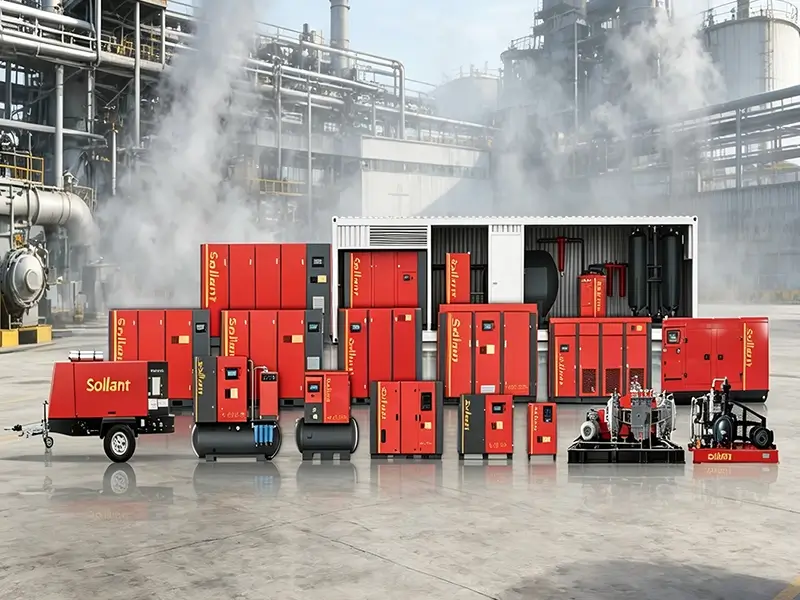
Catering to the diverse scales and process requirements of the textile industry, Sollant offers three primary categories of air compressors: oil-injected screw, oil-free screw, and centrifugal models. These products cover a comprehensive range of applications, spanning everything from small-to-medium-sized weaving mills to large-scale textile clusters.
Oil-Injected Screw Air Compressors
This is the most widely adopted and cost-effective compressor model within the textile industry, utilizing lubricating oil to seal and cool the compression chamber. Sollant offers two configurations: fixed-frequency and permanent magnet variable frequency (PM VFD). The PM VFD models automatically adjust their rotational speed based on the production line’s air demand; in scenarios involving significant fluctuations in air consumption—such as with air-jet looms—these units can achieve energy savings of over 30%. They are primarily suited for applications where air quality requirements are less stringent, such as open-end spinning, automatic winding, and workshop blow-down operations.
Oil-Free Screw Air Compressors
To meet the rigorous “zero oil content” requirements for compressed air in high-end textile processes, Sollant offers two distinct technical solutions: dry-type oil-free and water-lubricated oil-free compressors. The dry-type models achieve oil-free compression through the use of specialized coatings and precision-synchronized gears. The water-lubricated models, conversely, utilize pure water—rather than oil—to provide the seal; they also leverage water’s highly efficient heat dissipation capabilities to effectively operate within textile workshop environments, which are often characterized by high levels of cotton lint and challenging heat dissipation conditions. Both categories of oil-free compressors are capable of producing 100% oil-free compressed air, making them ideal for applications where zero tolerance for oil contamination is mandatory—such as air-jet weaving, air-flow dyeing, and high-end yarn-dyed fabric production.
Centrifugal Air Compressors
For large-scale textile mills housing hundreds or more air-jet looms, Sollant’s centrifugal compressors serve as the ideal base-load units for high-flow, continuous-operation environments. These units convert gas velocity into pressure energy via high-speed rotating impellers, delivering exceptional efficiency in scenarios requiring uninterrupted, 24-hour air supply. However, it is important to note that centrifugal compressors are relatively sensitive to pressure fluctuations; consequently, they are typically paired with variable-frequency screw compressors acting as “peak-shaving” units to collectively form a highly efficient, large-scale air supply system.
Frequently Asked Questions (FAQ)
Q: Should a textile mill choose a water-cooled or air-cooled air compressor?
A: If a circulating water system is available, water cooling is the superior choice; it offers stable cooling performance that remains unaffected by cotton lint in the workshop or ambient temperature fluctuations. However, if water resources are scarce, an air-cooled unit may be selected, provided that the ventilation design is sufficiently enhanced.
Q: How can the air leakage rate in a compressed air system be reduced?
A: The piping networks in textile workshops are often complex, resulting in air leakage rates that frequently reach as high as 20%–30%. It is recommended to use an ultrasonic leak detector on a regular basis, focusing particular attention on inspecting the connections at the looms.
Q: Are Variable Frequency Drives (VFDs) prone to burnout in textile mills?
A: Yes, this can occur if the VFD’s cooling fan ingests cotton lint, leading to overheating. When selecting equipment, it is advisable to specify that the VFD control cabinet be equipped with an independently sealed cooling air duct.
Conclusion
Selecting the right compressor for the textile industry is an art—one that requires balancing initial investment, operating costs, and risk mitigation. For enterprises committed to producing high-quality fabrics, the adoption of oil-free and variable-frequency technologies represents an irreversible trend.
By choosing a partner like Sollant—one that deeply understands textile manufacturing processes—you are not merely purchasing a machine; you are securing a long-term guarantee of efficiency for your production line.
Request a Quick Quote Now

Shandong Sollant Machinery Manufacturing Co., Ltd.
20 years of professional export experience. Our twin-screw air compressor is very popular in the international market.
