
Applications of Air Compressors in the Food Industry
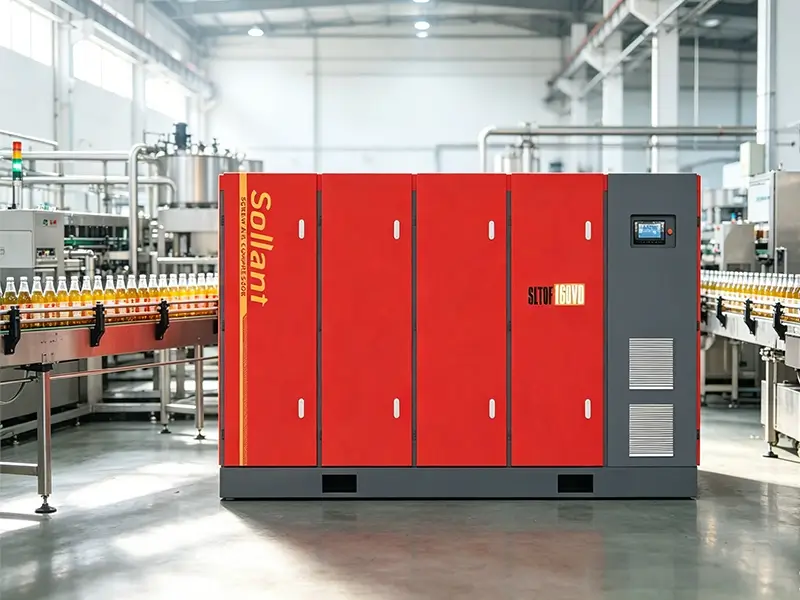
In the food and beverage industry, alongside water, electricity, and gas, “compressed air” is often referred to as the “fourth utility.” It serves not only as the power source for automated production lines but also as a critical medium directly involved in food production, packaging, and fermentation processes.
However, if this invisible and intangible air becomes contaminated, it transforms into an “invisible killer” for food safety. A single droplet of oil mist, a solitary dust particle, or even a trace of moisture imperceptible to the naked eye can directly lead to the spoilage of an entire product batch, alter its flavor profile, or even trigger a major food safety incident.
I. The Importance of Air Compressors in the Food and Beverage Industry
Step into a modern food processing plant, and you will find that compressed air is indispensable to nearly every stage of production—whether it involves automated packaging, pneumatic material conveying, PET bottle blowing, or instrumentation control.
However, the air requirements of the food industry differ starkly from those of a mechanical manufacturing facility. The core requirements for food-grade compressed air are “purity” and “safety.” According to SQF (Safe Quality Food) standards, any compressed air that comes into contact with exposed food products or food-contact surfaces must be free of any contaminants that could pose a food safety hazard.
If not properly managed, traditional oil-lubricated air compressors can generate oil vapors and mists that directly contaminate food products. This is precisely why the food industry is undergoing a comprehensive transition toward “oil-free” operations and “highly efficient purification.” To gain a deeper understanding of the core advantages of oil-free technology, please refer to our previous in-depth analysis: [Oil-Free Air Compressors: The Key to Clean and Efficient Air].
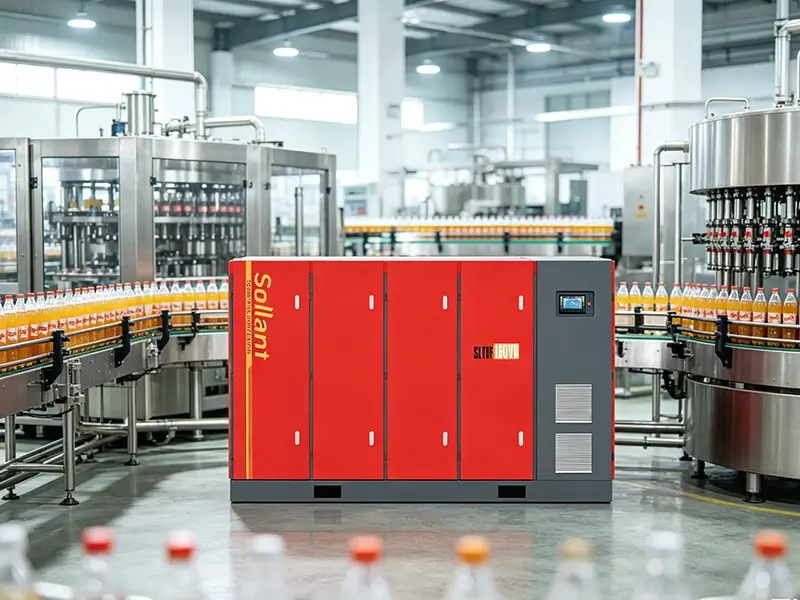
II. Key Applications of Air Compressors in Food Processing
Compressed air plays a multifaceted role within food processing plants; its specific applications can be broadly categorized as follows:
1. Pneumatic Actuation and Automation Control
This constitutes the most fundamental application. Compressed air drives pistons, cylinders, and valves to facilitate product movement, sorting, filling, and sealing operations. Compared to hydraulic systems, pneumatic systems are cleaner and eliminate the risk of contamination caused by oil leaks.
2. Product Transport (Pneumatic Conveying)
For powdery substances (such as flour, powdered milk, sugar, and spices) or granular materials (such as grains and coffee beans), utilizing compressed air to transport materials through pipelines offers an efficient and enclosed method. This not only reduces the need for manual handling but also effectively isolates the product from external dust and contaminants.
3. Cleaning and De-hulling
Prior to the processing of fruits, vegetables, or meat products, high-velocity compressed air can be used to blow away surface impurities, moisture, or residual shells/husks. For instance, in nut processing, airflow is utilized to separate the shells from the nuts.
4. Bottle Blowing and Container Molding
The production of PET bottles relies heavily on high-pressure compressed air. After preheating a preform (a tube-like plastic blank), high-pressure air is injected to expand it into the shape of the mold. This process demands extremely high standards regarding both the pressure stability and the oil-free purity of the air supply.
5. Packaging, Filling, and Nitrogen Generation
To extend shelf life, many food products (such as potato chips) require nitrogen-flushed packaging. Food processing plants typically utilize compressed air in conjunction with PSA (Pressure Swing Adsorption) nitrogen generators to produce nitrogen on-site.
6. Fermentation and Spray Coating
In the production of bread or fermented dairy products, compressed air is used to supply oxygen to fermentation tanks. Additionally, the application of syrup glazes or chocolate coatings to food surfaces is frequently accomplished using air-atomizing spray nozzles.
III. Common Types of Air Compressors in the Food Industry
Given the stringent hygiene standards involved, not all air compressors are suitable for use in the food industry. Based on the level of contact risk, the following three types are primarily recommended:
1. Oil-Free Screw Air Compressors (Preferred Choice)
This represents the mainstream choice for modern food processing facilities. Since no lubricating oil is used within the compression chamber, the risk of oil contamination is completely eliminated at the source.
Dry-Type Oil-Free Screw Compressors: The rotor surfaces feature a special coating; driven by synchronized gears, the rotors do not make physical contact with one another, thereby requiring no oil lubrication.
Water-Lubricated Oil-Free Screw Compressors: These units utilize pure water—rather than oil—for lubrication, cooling, and sealing purposes. Thanks to water’s exceptional cooling properties, these compressors can achieve near-isothermal compression, resulting in extremely high efficiency. Furthermore, the compressed air produced is absolutely oil-free—potentially even meeting the rigorous Class 0 standard. For processing environments where temperature sensitivity is a critical factor, this type of machine offers distinct advantages.
2. Oil-Free Scroll Air Compressors
It is suitable for low-to-medium flow scenarios, such as laboratories, small-scale packaging lines, or brewery fermentation rooms. It features a simple structure, minimal moving parts, and extremely low noise levels.
3. Two-Stage Screw Air Compressors
These units are primarily utilized in process stages where there is no direct contact with food products, or as a general-purpose pneumatic power source for the facility. By employing a two-stage compression process, they reduce the compression ratio required at each stage, thereby enhancing energy efficiency. However, if they are to be used in scenarios involving direct contact with food products, they must be paired with a sophisticated filtration system.
Selection Tip: If the compressed air will come into direct contact with food products (e.g., during mixing, packaging, or cleaning), it is imperative to select an **oil-free air compressor**. Conversely, if the air is used solely to drive pneumatic cylinders, valves, or other components that do not come into contact with the product, an oil-lubricated compressor may be used; however, it remains mandatory to install a high-efficiency oil-water separator and an activated carbon filter to ensure air purity.
4.Oil-Injected Screw Air Compressors
Although the compressor unit contains lubricating oil, an exceptionally high level of purity can be achieved through a highly efficient multi-stage filtration system.
Note: Food-grade lubricant (H1 classification) must be used. However, should a filter element fail, a risk of contamination exists; therefore, these compressors are typically employed only in applications where there is no direct contact with food products.
IV. Key Processing Equipment for Food-Grade Compressed Air
Possessing a high-quality compressor alone is insufficient; it is the “post-processing” of the compressed air that is the critical factor in determining whether it meets food-grade standards.
Dust Filters: Remove solid particles.
Oil Removal Filters: Coalesce and discharge oil mist.
Activated Carbon Filters (Odor Removal): Adsorb airborne hydrocarbons and odors, ensuring the purity of the food product’s taste.
2. Air Dryers
Moisture serves as a breeding ground for microorganisms.
Refrigerated Dryers: Lower the dew point to approximately 3°C, suitable for most pneumatically driven applications.
Desiccant Dryers: Adsorb moisture using desiccant materials; capable of achieving dew points of -40°C or lower, making them suitable for high-standard processes involving direct contact with food products.
In addition to storing air and stabilizing pressure, air receivers also serve the functions of preliminary condensation and the removal of accumulated water.
4. Oil-Water Separators
Process condensate discharge, ensuring that factory effluent complies with environmental protection standards.
V. Contaminants and Their Hazards in Food Processing
If improperly managed, compressed air may introduce the following four categories of critical threats:
| Type of Contaminant | Source | Potential Hazards to Food |
| Solid Particles | Environmental dust, pipe rust and scale | Causes a sensation of foreign matter, damages seals, and harms precision-machined equipment. |
| Liquid Water / Steam | Atmospheric Humidity | Leads to the proliferation of bacteria and mold; causes equipment corrosion; alters the texture of dry powdered foods. |
| Oil Mist / Oil Vapor | Compressor Lubricants; Atmospheric Pollution | Generates unpleasant odors; causes chemical contamination; leads to product returns or large-scale recalls. |
| Microorganisms | Bacterial Proliferation in Humid Environments | Shortens product shelf life; triggers serious public health and safety incidents. |
VII. Discover Sollant’s Air Compressors for Food Packaging
Among the multitude of air compressor manufacturers, Sollant offers highly specialized and precisely tailored solutions for the food and beverage industry. This explains why so many beverage production facilities place their trust in Sollant’s oil-free screw air compressors. Given that the food industry is currently undergoing a continuous transformation—shifting from a singular pursuit of “low cost” to a focused emphasis on “high quality and safety”—Sollant’s product advantages are primarily demonstrated in the following key areas:
1. Absolute Oil-Free and Pure Technology
Sollant’s flagship water-lubricated oil-free screw compressors utilize pure water as the lubricating medium, thereby achieving ideal isothermal compression. This not only delivers absolutely oil-free air—certified as Class 0—and completely eliminates the risk of oil contamination in products, but also results in lower discharge temperatures, significantly reducing the operational load on downstream air drying equipment.
2. Integrated Post-Processing Solutions for High Standards
Sollant offers more than just air compressors; it provides “one-stop” compressed air systems. Specifically tailored for packaging and fermentation processes, their solutions integrate high-precision filters and dryers to ensure that the air delivered to packaging lines maintains a stable dew point of -40°C—fully meeting the rigorous standards required for PET bottle blowing and direct food contact applications.
3. Eco-Friendly Energy Efficiency and Intelligent Control
For food manufacturing facilities—environments characterized by continuous, 24-hour operations—energy consumption represents a substantial cost factor. Sollant has incorporated Variable Speed Drive (VSD) technology, which automatically adjusts motor speed in real-time based on actual air demand. In the context of industry trends projected for 2025–2026, energy conservation has emerged as a core element of corporate competitiveness. By optimizing rotor profiles, Sollant’s equipment achieves energy savings of 20% to 30% compared to traditional models; for enterprises like Yihai Kerry—which prioritize Grade 1 energy efficiency for their air compressor stations—this translates into annual electricity cost savings amounting to millions of kilowatt-hours.
4. Guaranteed Stability
Sollant’s products are designed to meet rigorous durability standards, ensuring a continuous, pulsation-free, and stable air supply—whether powering pneumatic conveying systems in biscuit factories or driving homogenizers in dairy processing plants.
The air compressor serves not only as the power engine for food production but also as the first line of defense for food safety. As consumer expectations regarding food quality continue to rise, the adoption of oil-free, energy-efficient, and stable compressed air systems is no longer merely an option, but a core element of corporate competitiveness.
Sollant provides you with oil-free, energy-efficient, and intelligent compressed air solutions, empowering food enterprises to achieve their goals for green, low-carbon, and sustainable development while simultaneously safeguarding “safety on the tip of the tongue.”
Request a Quick Quote Now

Shandong Sollant Machinery Manufacturing Co., Ltd.
20 years of professional export experience. Our twin-screw air compressor is very popular in the international market.
