
In today’s pharmaceutical industry—as the focus shifts from mere “manufacturing” to “quality manufacturing”—every detail of the production environment bears directly upon the safety of patients’ lives. As the second-largest power source after electricity, compressed air plays a pivotal role in pharmaceutical processes. However, if this compressed air is impure, it can become the number one “invisible killer” of pharmaceutical products.
Applications of Air Compressors in the Pharmaceutical Sector
In modern pharmaceutical manufacturing facilities, compressed air systems are hailed as the “lifeline” of production. Their applications span the entire production workflow, primarily encompassing the following areas:
- Process Air: Directly involved in chemical reactions, spray drying, oxygen supply to fermentation tanks, pneumatic mixing, and raw material conveyance. In these stages, the air comes into direct contact with the pharmaceutical products.
- Aseptic Filling and Packaging: Powering filling machines for liquid dispensing, facilitating the forming and sealing of aluminum-plastic blister packaging, and enabling capsule filling operations.
- Instrumentation and Automation: Providing stable pneumatic power to valves, actuators, and precision analytical instruments (such as gas chromatographs) located within cleanroom environments.
- Cleaning and Purging: Drying vials and ampoules following washing procedures, as well as purging and clearing equipment pipelines.
Should the compressed air become contaminated, the consequences can range from minor issues—such as product deliquescence or reduced therapeutic efficacy—to severe repercussions, including major product recalls and even threats to patient safety.
Why Must the Pharmaceutical Industry Choose “Oil-Free” Technology?
In the past, many pharmaceutical manufacturers attempted to “purify” air from oil-lubricated compressors into oil-free air by utilizing downstream filters. However, this reliance on “filtration” is gradually being phased out in the face of stringent GMP compliance requirements.
Why is the selection of oil-free air compressors mandatory?
The fundamental reason lies in risk management. Even minute traces of lubricating oil—primarily composed of hydrocarbons—that enter the compressed air system can undergo thermal cracking under conditions of high temperature and pressure. This process generates complex compounds containing carbon monoxide, aldehydes, and even potent carcinogens such as benzo(a)pyrene. While filters can effectively intercept liquid oil mist, their efficiency in capturing nanoscale oil vapor is extremely low; furthermore, should a filter element become saturated and fail, oil contaminants will directly “breach” the protective barrier.
By opting for oil-free compressors—such as dry-screw or water-lubricated screw models—manufacturers physically eliminate the possibility of lubricating oil entering the compression chamber, thereby achieving zero oil contamination. This represents the only viable choice for ensuring pharmaceutical safety and regulatory compliance.
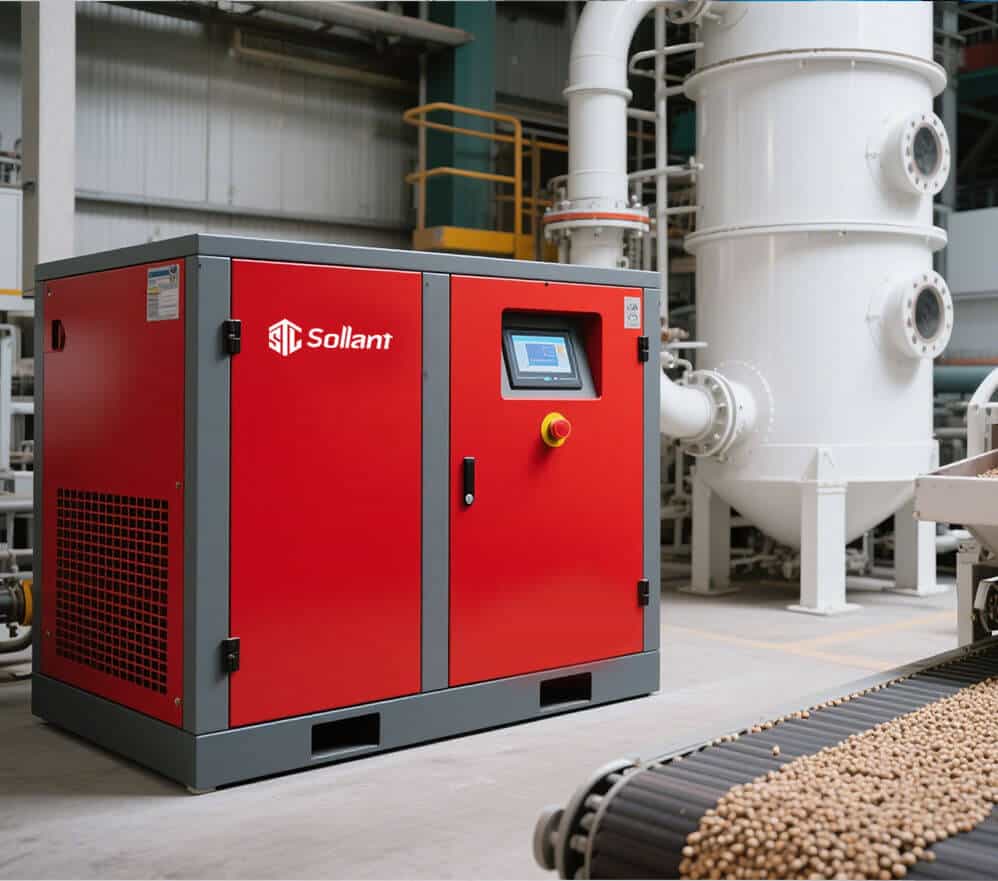
The Four Core Pain Points of Compressed Air in the Pharmaceutical Industry
| Pain Points | Impact on Pharmaceutical Manufacturing | Sollant Solutions |
| 1. Oil Contamination | Mixing of oil mist with pharmaceutical products → Chemical contamination, batch spoilage, safety hazards | ✅ 100% Oil-Free Technology (Dry Screw / Scroll) ✅ Real-time Online Oil Mist Monitoring System |
| 2. Excessive Moisture | Pipe corrosion, bacterial growth, moisture damage to hygroscopic pharmaceuticals | ✅ Combination of High-Efficiency Refrigerated and Adsorption Dryers ✅ Pressure Dew Point Achieves -40°C to -70°C |
| 3. Microorganisms / Active Particles | Contamination of sterile preparations (e.g., injectables, eye drops) | ✅ 0.01 μm-grade sterilizing filters (capable of removing bacteria and viruses) ✅ Optional high-temperature sterilization post-treatment equipment |
| 4. Unstable Air Supply | Abnormal operation of filling and tablet-pressing machines → Increased reject rate | ✅ Variable Frequency Constant Pressure Control (Pressure fluctuation ≤ ±0.1 bar) ✅ Multi-unit Integrated Control + Redundant Design |


Request a Quick Quote Now
Order or No Order? We're here for you 24/7

